Zellwood, Florida  ·  A Local History

Before the Sweet Corn,
Zellwood Was Sold by Mail


A Philadelphia encyclopedia man mailed scrapbooks of Florida to his old Army friends to talk them into wintering here. A freeze killed their groves. So the town drained a lake and made twenty thousand acres of new ground. The one thing Zellwood never ran short of was room.

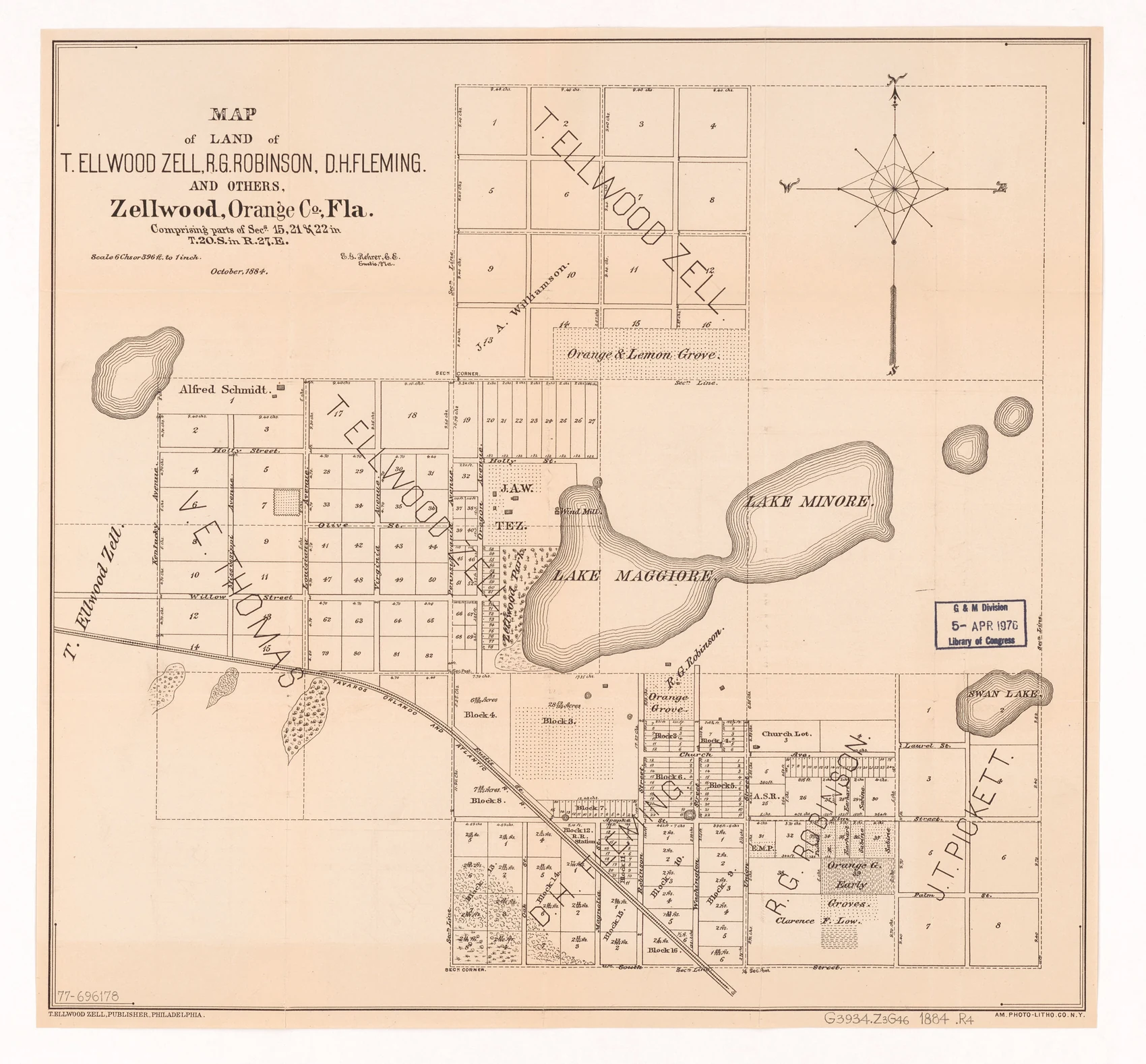
An 1884 surveyor's plat titled 'Map of Land of T. Ellwood Zell' laying out the town of Zellwood in numbered lots and blocks, with two lakes labeled Lake Maggiore and Lake Minore, an orange and lemon grove, named streets, and a railroad crossing the lower corner.
Zellwood, drawn up — October 1884
The town before it existed. A publisher in Philadelphia paid a surveyor to lay his Florida land out in tidy lots and blocks, name the streets, and letter his own name across the top — then sell the pieces by mail. “Map of Land of T. Ellwood Zell, R. G. Robinson, D. H. Fleming and others, Zellwood, Orange Co., Fla.,” surveyed by E. G. Rehrer, 1884; published by T. Ellwood Zell, Philadelphia. Library of Congress, Geography & Map Division.

Somewhere in Philadelphia around 1876, a man who had made a comfortable living printing encyclopedias started cutting up newspapers. He clipped every hopeful little item he could find about a warm, cheap corner of Florida, pasted them into scrapbooks, and mailed those scrapbooks to his friends — a lot of them old Union officers he knew from the war. The pitch was simple. Come down here. There’s more land than you know what to do with, and it’s practically being given away.

His name was T. Ellwood Zell, and it worked well enough that the place got a post office in 1877 and started calling itself after him: Zellwood. A whole town, more or less conjured out of a mailing campaign before anybody called it that.

So what was he actually selling? Not a view, not a climate, though he mentioned both. He was selling room.

The pitch was always room

You can see it right there on the map he had drawn in 1884, up at the top of this page. Zell didn’t just own some acreage — he platted it, chopped it into numbered lots and blocks, laid out streets with names, and marked the groves. He even named the two little lakes at the center of it, and this is the part that tells you exactly who he was: he called them Lake Maggiore and Lake Minore. Bigger Lake and Smaller Lake, in slightly bungled Italian, for two ponds in the Florida pinewoods.

A close detail of the 1884 Zellwood plat showing the numbered town lots, a block marked Zellwood Park, named avenues, an orange and lemon grove, and the two lakes labeled Lake Maggiore and Lake Minore.
He even named the two ponds
Lake Maggiore and Lake Minore, dead center — a grand name for a pair of ponds, with the lots, the avenues, and “Zellwood Park” penciled in around them. Detail of the 1884 Zell plat; Library of Congress.

The county was in on the same sell. Its immigration pamphlets of the early 1880s promised a school, a post office, a railroad on the way, and land in five- and ten-acre lots — perfect, they said, for growing oranges and lemons and limes. For a family worn thin on a tired Northern farm, five or ten acres of warm ground you could own outright was the whole dream. You came for the space, and you planted it in citrus.

And some people came for a great deal more space than that.

The steel man’s winter room

Around the turn of the century, the son of a Pittsburgh steel baron picked this same pine corner to winter in. James Laughlin Jr.’s family ran one of the largest steel companies on earth, and when he built his winter place out here — finished around 1904, a sprawling Mediterranean-style house he named Sydonie for his wife — he built it the way a steel fortune builds.

The Sydonie Mansion today: a long three-story stucco house with a red tile roof, multiple chimneys, a deep columned veranda, palms and a wide front lawn under a blue sky.
The steel man’s winter place (now)
Sydonie, still standing in Zellwood. The steel heir’s winter house — thirteen bedrooms, its own groves and dairy and power plant — photographed in recent years, long after the family sold it. Photo by Ebyabe, 2017, via Wikimedia Commons (CC BY-SA 4.0).

Thirteen bedrooms. Citrus groves of his own, a dairy, a power plant to run the lights, and a bowling alley because why not. It was the exact same instinct the five-acre settlers had, only with a steel heir’s budget behind it: get yourself a big piece of ground, and then build whatever you please out on it.

Rich man or tired farmer, the whole place ran on one bet. Oranges.

A black-and-white photograph of a mature central-Florida orange grove, round-topped citrus trees in rows across sandy soil, from the late nineteenth century.
The whole bet, in rows
A central-Florida orange grove of the kind Zellwood lived on, photographed before the freezes of the 1890s. Detroit Publishing Co.; Library of Congress — a representative grove of the era, not Zellwood itself.

For a while the bet paid beautifully. The groves came in, the fruit rode the new railroad north to people who’d never seen an orange on a branch, and a man could stand on his own warm acres and feel like he’d gotten in early on something.

Then two winters settled the argument.

The freeze that emptied the groves

The back-to-back freezes of 1894 and 1895 are the ones Florida growers still talk about. A hard freeze like that doesn’t just knock the fruit down — the trees themselves split and blacken and die on their feet, years of patient growing gone in a couple of cold nights.

A sepia 1895 photograph of an orange grove killed by a hard freeze: bare, damaged trees behind a wooden fence, a ladder leaning against one trunk.
After the freeze — 1895
A grove after the 1895 freeze, a picking ladder still leaning on a tree nobody would need to pick. Images of Central Florida, Orange County Regional History Center, via the University of Central Florida.

All across west Orange County the little grove colonies emptied out. Plenty of the winter-colony towns the railroad brochures had dreamed up simply quit after that and never came back. Zellwood took the hit like everyone else.

But here’s where Zellwood turns out to be a different kind of town. It didn’t just sit and wait for the next crop to replace the one the freeze took. A half-century later, it went and made itself an entirely new piece of ground — by draining a lake.

The twenty thousand acres under the water

During the Second World War, with the country short on food, the state set up a drainage district and went to work on the north shore of Lake Apopka, the big shallow lake just south of town. They threw up dikes, pumped the water off, and uncovered the lake bottom.

What was under there was black muck — thousands of years of rotted-down marsh, piled into some of the richest farm soil in Florida. Twenty thousand acres of it, dry for the first time, flat as a table and black as coffee. The town had answered a dead citrus crop by manufacturing new farmland where a lake used to be.

A 1937 photograph of a flat central-Florida muck field: dark plowed soil in long rows running to a distant tree line and a couple of low barns, with a lone figure walking the field.
The black muck — central Florida, 1937
Flat black ground, carved out of the pinewoods. A drained muck vegetable field in central Florida — the same kind of black lake-bottom soil Zellwood farmed on Lake Apopka’s north shore. “The celery fields at Sanford, Florida,” Farm Security Administration, 1937; Library of Congress — a representative muck field of the region, not Zellwood itself.

And that ground grew vegetables like it had a grudge. Lettuce, radishes, cabbage, carrots, onions — and above all, sweet corn. Zellwood corn got a reputation good enough that growers banded together to sell it under one name, and the little town that a publisher had mailed into existence became a place people drove to for a vegetable.

A 1937 photograph of a crew of field workers harvesting a central-Florida vegetable field by hand, bending over the rows with wooden crates, low farm sheds on the flat horizon behind them.
Working the muck
Hands in the black soil. A field crew harvesting a central-Florida muck field by hand in 1937 — the same back-bending work that filled the crates on Lake Apopka’s north shore for most of a century. Farm Security Administration; Library of Congress — representative of the region’s muck farming, not Zellwood itself.

By the end of the 1960s the whole town leaned into it. A crew of locals started boiling corn for a community fundraiser, and it grew into the Zellwood Sweet Corn Festival, with a cast-iron cooker the size of a boat trailer — they named her Big Bertha — steaming thousands of ears at a go. For a few decades every spring, that was the thing you knew Zellwood for.

A freeze took the groves. So the town pulled twenty thousand acres out from under a lake and grew corn on it. When Zellwood ran out of one kind of room, it built another.

What the lake took back

There was a bill for all that, and the lake paid it. Season after season the muck farms were flooded to protect the soil and then drained again, and the water that ran back into Lake Apopka carried the farms’ fertilizer and pesticide with it. One of the best bass lakes in Florida slowly went green and sick. The fish camps that had lined it closed, one after another.

So in the end the state did the thing that sounds impossible: starting in the late 1990s, it bought the muck farms back, shut them down, and began letting the north shore go toward marsh again, to heal the lake. The made ground, after sixty years of corn, started turning back into water and birds.

A present-day photograph of a great blue heron standing in green marsh grass along the restored north shore of Lake Apopka, water in the foreground.
The lake, taking it back (now)
The north shore today, where the muck farms were — a heron on the restored edge of Lake Apopka, the old farm ground going back toward marsh. Present-day photograph via Wikimedia Commons (CC BY 3.0).

The corn festival wound down. The last of the big muck farms is long closed. If you want a Zellwood story that ends with the thing it was most famous for, there isn’t one — the sweet corn moved on.

The one thing that stayed

And yet the town is still here, because the town was never really the groves or the corn. It was the ground. Zellwood sits on the high, roomy pine land just back from the lake — the part nobody had to drain, the part that doesn’t flood. Through every version of this place, that is the thing that never changed: out here there has always been more land than any one house strictly needs.

A present-day color photograph of a Florida orange grove: two rows of fruit-laden orange trees with a sandy lane running between them toward open sky.
Still planted — the room, in rows (now)
Groves still hanging on around Zellwood today — fruit on the trees, a sand lane between the rows, open ground at the end of it. Representative present-day central-Florida grove, via Wikimedia Commons.

Drive through Zellwood now and you’re back in that old habit of spreading out. Groves that outlived the freezes. Pastures and plant nurseries. Big unincorporated lots where the next house is a long way off. A quiet community of older folks sitting on what used to be a grove estate. A few thousand people spread across a handful of square miles — a town that has always had the room to be whatever it needed to be next.

The encyclopedia man sold that room by mail a hundred and fifty years ago. Nobody’s mailing scrapbooks anymore, but the ground he platted is still sitting out there behind the fences — more of it than the house in front of you needs — waiting on the next good idea.

A present-day note · Orange Tiny Homes

The next good idea usually goes out back.

Zellwood has spent a century and a half finding new uses for the same open ground — a grove, a steel baron’s estate, a drained lake, a corn field, a pasture. That’s the old rural-Florida habit, and it hasn’t gone anywhere: if you’ve got the land, you build what you need on it, and usually you build it out back.

These days that second building has a name — an ADU, an accessory dwelling unit — and it’s what we build. A granny flat so a parent can live close and still have their own front door. A guest house. A rental out back that helps carry the place. A tiny home on the far corner of the lot. Same instinct those roomy Zellwood lots were platted for, just with a kitchen, a bathroom, and a permit.

And you don’t need a homesteader’s acreage to do it. Across greater Orlando and Orange County — the big grove-and-pasture lots out by Zellwood, Clarcona, and Wedgefield, sure, but also ordinary yards in Apopka, Ocoee, Winter Garden, and Pine Hills — a lot of homes already have the space. What actually decides it comes down to your specific address:

The real answer to “is there room out back for this?” isn’t a guess — it’s a handful of facts about your lot. That part we can check for you.

Put in your address and we’ll pull what your parcel allows and tell you whether a granny flat, guest house, rental, or tiny home actually fits — before you spend a dollar on drawings.

Start the ADU Fit Check→
Sources & Photo Credits

On the history

Zellwood’s nineteenth-century story survives mostly in local-history accounts, a few surviving maps, and the record of Lake Apopka, rather than a deep photographic archive of the town itself. Where this page shows a muck field, a grove, or a pine landscape from elsewhere in central Florida, it is labeled as a representative image of the region and the era, not a photograph of Zellwood. The 1884 Zell plat is a primary source for the town’s original layout and the names of its lakes and streets. Full notes in source-record.md.

Photographs & documents

  1. Map of Land of T. Ellwood Zell, R. G. Robinson, D. H. Fleming and others, Zellwood, Orange Co., Fla. — surveyed by E. G. Rehrer; published by T. Ellwood Zell, Philadelphia, 1884; public domain, Library of Congress, Geography & Map Division. Shown as the hero and as a center detail (Lakes Maggiore and Minore and the town lots). Files: zell-land-plat-1884-hero, zell-land-plat-1884-detail. loc.gov
  2. Sydonie (James Laughlin Jr.) Mansion, Zellwood — present-day photograph of the genuine historic house (finished c. 1904), by Ebyabe, 2017; Wikimedia Commons, CC BY-SA 4.0. File: sydonie-mansion-today. Commons
  3. Orange grove, Seville, Fla. — Detroit Publishing Co., between about 1880 and 1897; public domain, Library of Congress Prints & Photographs. A representative pre-freeze central-Florida grove, not a Zellwood location. File: orange-grove-pre-freeze-1880s. loc.gov
  4. Frozen orange grove, 1895 — “Photograph of Frozen Grove, With Ladder Against a Tree, 1895,” Images of Central Florida, Orange County Regional History Center, digitized by University of Central Florida Libraries (STARS). Representative of the Great Freeze. File: frozen-orange-grove-1895. stars.library.ucf.edu
  5. “The celery fields at Sanford, Florida,” 1937 — Farm Security Administration (Arthur Rothstein); public domain, Library of Congress Prints & Photographs. A representative drained-muck vegetable field of the central-Florida muck belt, not Zellwood itself. File: muck-field-sanford-1937. loc.gov
  6. Harvesting a central-Florida muck field, 1937 — “Harvesting celery at Sanford, Florida,” Farm Security Administration; public domain, Library of Congress Prints & Photographs. Representative of the region’s hand-harvested muck farming, not Zellwood itself. File: muck-harvest-sanford-1937. loc.gov
  7. Lake Apopka north shore — present-day photograph of a great blue heron on the restored north shore (the former muck-farm ground); Wikimedia Commons, CC BY 3.0. File: lake-apopka-north-shore-heron-today. Commons
  8. Florida orange grove — present-day photograph, 2013; Wikimedia Commons, released CC0 (public-domain dedication). A representative present-day central-Florida grove. File: fl-orange-grove-today. Commons

Original downloads and a full research record are kept alongside this page in assets/images/originals/ and source-record.md. Present-day photographs are labeled (now); representative images (the pre-freeze and present-day groves, the 1937 muck fields, and the restored-lake view) are identified as such in their captions. No historical image was altered in any way that changes its content; the Polaroid frames and handwritten notes are CSS added around the photographs, never onto them.