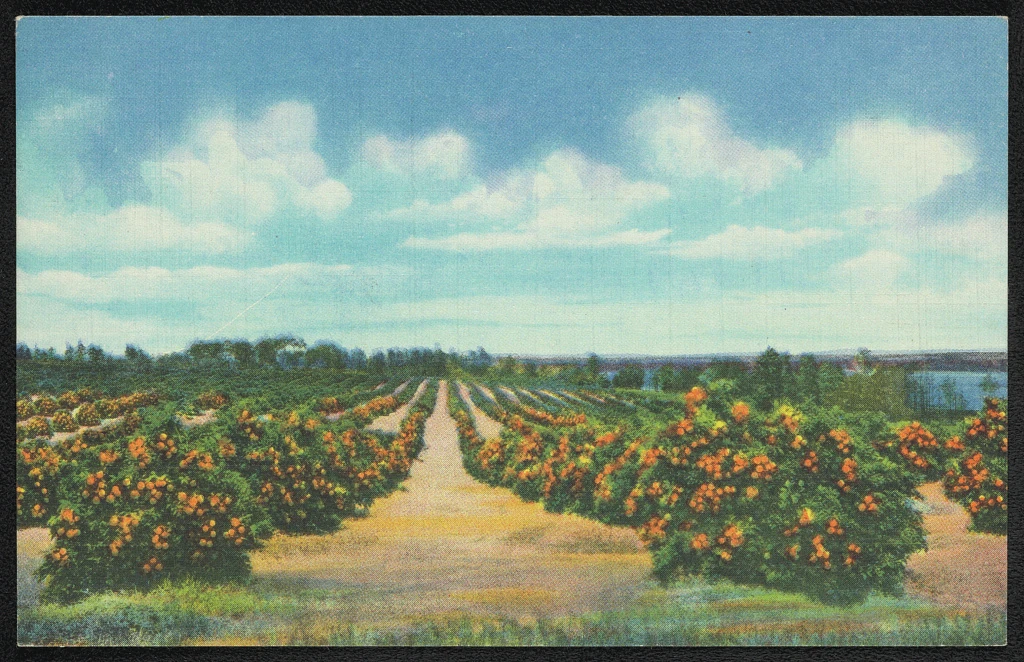
There’s a dead man’s name all over this stretch of road between Winter Garden and Oakland. It’s on the elementary school. It’s on Tildenville School Road. And for about sixty years it rode out of here stamped on the side of every wooden crate of oranges that left the place — three letters, L.F.T. The man was Luther Fuller Tilden, and he came down to Florida in the 1870s because a doctor up north had listened to his chest, heard bronchitis, and more or less told him to go somewhere warm while he still could.
He did not go quietly. He bought five hundred and sixty-one acres of high, sandy ground on the south shore of Lake Apopka — nine dollars an acre — and planted a town.
That’s the odd thing about Tildenville. It isn’t named for a battle or a railroad or a saint. It’s named for the farmer who owned it, because the whole place grew outward from his groves the way a tree grows out from its trunk. And the reason it could is the plainest thing in the world. Out here, there was room.
What one man does with that much room
The first thing he did was figure out the fruit. Back then an orange got to market however it survived the trip — packed badly, or not packed at all, and bruised to mush by the time it reached a cold city up north. Tilden packed his right, and he put his initials on the crate so a merchant in Baltimore or New York knew what he was getting before he even pried the lid. L.F.T. meant Luther had packed it; C.H.T. meant his son Charles had. Same promise either way.

Before the railroad reached this corner, getting the crop out was its own feat — hauled by ox and mule team up to Sanford, then floated down the St. Johns River to Jacksonville and the ships. The Tildens kept buying ground and planting it, and within a generation they were one of the biggest landowning citrus families in this part of the state.
And an operation that size isn’t just trees. It’s a whole machine, and Tilden built every part of it out on his land because he had the land to build it on. A growers’ association went up over in Oakland, with a packinghouse on Tildenville School Road and its own brands on the crate — South Lake, Good Will. That same packinghouse ran a power plant, and starting around 1910 it sent electricity into the houses of Tildenville and Oakland, with one catch a modern person can barely picture: every night at eleven o’clock they shut the whole thing off, and the town went dark till morning.

By 1919 the family and their partners had spun up the Tildenville Power Company, and the next spring it was lighting Winter Garden too. A schoolhouse had already gone up back in 1905, on land a neighbor family gave. A town made out of fruit still needs the things a town needs, and one by one, on that room, they got built.
Who actually picked it
A grove, though, is only worth what somebody’s willing to climb a ladder in the heat to pick. The oranges didn’t gather themselves, and the people who gathered them are half the reason there’s still a Tildenville at all.

A county history tells it plainly: the first residents were mostly people who came up from Alabama and Georgia to work the groves, and stayed. Many were Black families, and the work — picking, hauling, packing, grove after grove — ran on them. They lived where the work was, in modest wooden houses built right out among the trees on the grove land. A settlement grew up here through the 1930s and ’40s. Nearly twenty of those little labor houses are still standing. A church went up in 1939, and for decades its lights were the only streetlights the neighborhood had.
The Tildens grew vegetables too — they were among the first in the state to ship them — so between the groves there were fields: beans, cabbage, the muck crops that liked the low wet ground down near the lake. Picking season, packing season, planting season. For a long time there was always work, and the work was always right here.

The two freezes
Florida citrus has one mortal enemy, and it isn’t bugs. It’s a cold night.

The first time it nearly ended everything was the winter of 1894 and ’95 — the Great Freeze, the one old Florida families still measure time by. It killed the trees across the middle of the state and sent ruined settlers packing. Tilden, who by then had money, lent out his animals and his equipment and carried neighbors who’d lost everything, and slowly the groves came back.
The second time, they didn’t. The hard freezes of the 1980s came through and finished the citrus in this part of Orange County for good — the growers who rebuilt did it a hundred miles south, and up here the groves just stopped. The picking work that had pulled families from Alabama and Georgia dried up with them.

And the lake itself, the one Tilden had settled beside, was in its own slow trouble. Decades of farm runoff off the far shore had turned one of the finest bass lakes in the country into one of the most polluted lakes in the state; the fish camps that once ringed it closed one after another. The oranges left. The fish left. The thing the whole town had been built on was, almost all at once, gone.
What a town’s made of, after
So go looking for the groves today and you mostly won’t find them. Subdivisions, the Turnpike, a shopping center carrying the Tilden name. The south end of the old community got sliced clean off into a little pocket called Possum Hollow when the Turnpike went through.
Out here the land was never the scenery. It was the asset — the thing a whole life got built on top of.
But the room is still legible, if you know how to read it. The big packinghouse buildings still stand on Tildenville School Road, rented out now to small businesses. Two of the houses Tilden built are still there. His son’s place — a wide-porched Classical Revival house called Meadow Marsh, out on its acreage — is somebody’s home again after years as an inn. Nearly twenty of the grove-workers’ houses are still lived in. The church still gathers. The families who came to pick and stayed seventy years are still here.

The old rail line that carried the fruit out is a paved trail now, and it runs straight through the middle of Tildenville, past the grove ground, under the live oaks. People walk it in the evening along the same route the oranges once took out of town.

The oranges are gone. The man who stamped his initials on them has been gone since 1929. The lake nearly died. But the road still carries his name, and the houses — the grand ones he built and the plain ones his workers built — are still standing on the same wide ground that made all of it possible in the first place. A town that started as one man’s orange grove turned out to be built by everyone who came to pick it. And the thing it was really made of, the thing that outlasted the fruit and the freezes and the lake, was never the citrus. It was the room, and what people kept deciding to put on it.

