Windermere, Florida  ·  A Local History

They Named It the Isle of Worth
Because the Cold Couldn’t Reach It


On the west side of Orlando there’s a chain of lakes that was once wrapped in orange groves, one of them so large and so sure of itself that the family who planted it bet the frost would never find it. The frost found it. Twice. What’s left where the groves stood, in gated neighborhoods like Tilden’s Grove, isn’t the fruit. It’s the room.

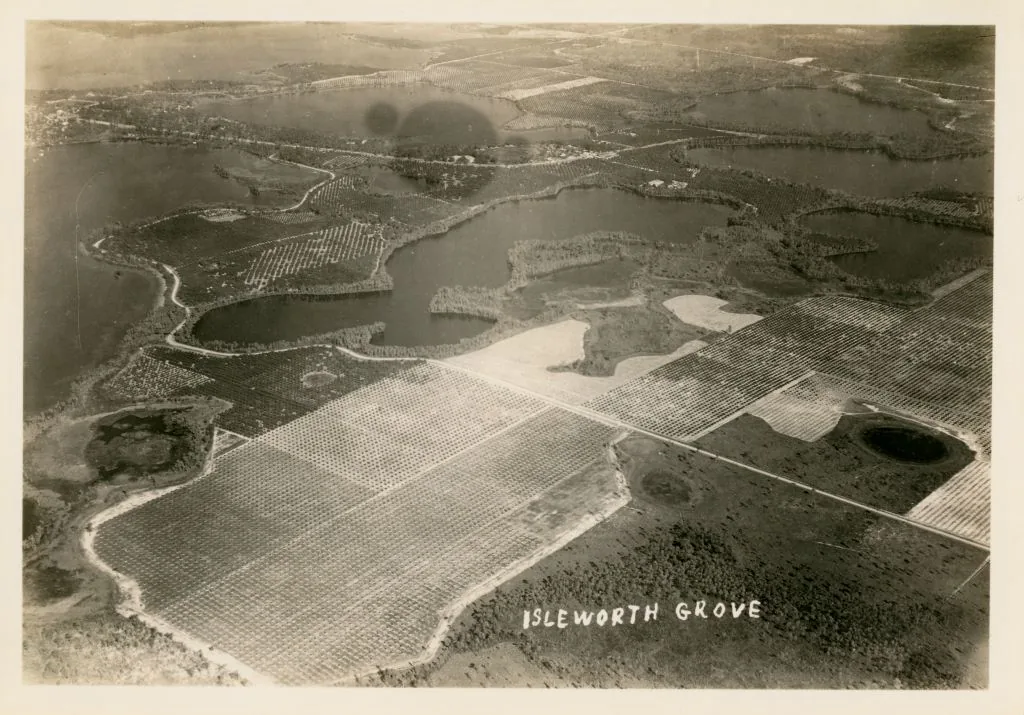
A 1936 aerial photograph of Isleworth Grove: a vast geometric carpet of citrus trees wrapping around open fields and the dark water of the Butler Chain of Lakes, the words ISLEWORTH GROVE lettered across the lower edge.
Isleworth Grove, from the air
Thirteen hundred acres of oranges, wrapped around the water. Aerial of Isleworth Grove on the Butler Chain of Lakes near Windermere, March 3, 1936. Chase & Company, Chase Collection (MS 14), University of Florida; via RICHES of Central Florida, UCF.

Drive out the west side of Orlando, past the sand roads and the chain of lakes around Windermere, and you’ll pass a gated neighborhood with a grove right there in its name: Tilden’s Grove. There is not an orange tree in it. A few minutes on, where the golf mansions start, you’re standing on what a citrus family out of Philadelphia once called the Isle of Worth, thirteen hundred acres of oranges they were so certain the cold could never reach that they named the whole place after the bet.

Both names are headstones. And the odd thing about this corner of Orange County is how many of its priciest addresses are quietly named for the thing that used to grow where the houses are now.

So here’s the question worth asking, standing on a lawn in a place called a grove with no grove in sight: what were they so sure about, and what happened to it?

The bet on the lakes

Start with why anyone planted oranges here in the first place. An orange tree is a tropical thing living somewhere that gets the occasional killing cold snap, and a grower’s whole life rides on guessing where the cold won’t settle. Water is the trick. A big lake holds the day’s heat and stays warmer than the land around it on a freezing night, and it breathes that warmth back onto the shore. So the ground around a deep chain of lakes was, in theory, the safest citrus ground in the state.

Three citrus workers in shirtsleeves and hats standing by a tree draped with cloth and a stack of buckets in the grove, in a mounted black-and-white photograph from 1904.
The men who worked it, 1904
A grove is people before it’s fruit. Three workers at Isleworth Grove, 1904. Chase & Company, Chase Collection, University of Florida; via RICHES of Central Florida, UCF.

Two brothers from Philadelphia, Joshua and Sydney Chase, believed that theory enough to buy into it. Their company dated to 1884; by 1886 they had put together a grove on the Butler Chain near Windermere that ran to thirteen hundred acres. They called it the Isle of Worth, because the trees out there seemed to shrug off the cold snaps that burned other groves. The name was a brag with a reason behind it.

And they weren’t the only ones. Windermere itself got its start in 1887, when an Englishman named John Dawe laid out a town between the lakes and named it after a lake back home in England. By 1910 a local improvement company was selling the place as a citrus paradise, and thousands of acres of orange trees went in around the water. For a stretch there, this was one of the largest citrus regions on earth. The lakes were the whole argument.

What a grove that size really is

A grove of thirteen hundred acres isn’t a quiet orchard. It’s a small industry with a town attached. Somebody has to bud the trees, nurse them through the bugs, pick the fruit by hand, grade it, pack it, and move it north before it spoils. The people who did all that lived right out on the grove, in houses among the trees.

Grove workers beside orange trees that have been draped with large sheets and tents for fumigation, a wagon and equipment nearby, in a 1904 photograph.
Tenting the trees
Covered, then smoked. Workers fumigating citrus trees under tents at Isleworth Grove, 1904. Chase & Company, Chase Collection, University of Florida; via RICHES of Central Florida, UCF.

They draped whole trees and smoked them to kill the scale. Ledgers from the Isleworth grove in the 1930s list dozens of families, Black and white, living and working on the place, their wages logged season by season. The grove was their town the way a mill or a mine was somebody else’s.

Men loading bulk citrus into a truck beside a line of young palms and a rail siding at the grove, in a January 1953 photograph.
Loading out
Getting it north before it spoils. Loading fruit at Isleworth Grove, January 1953. Chase Collection, University of Florida; via RICHES of Central Florida, UCF.

And the fruit went a long way. Isleworth oranges were good enough that the company carried a display of them all the way to the New York World’s Fair, stacked in crates under a painted Florida sky for the crowds out in Queens. About as far from a sand road in Orange County as an orange could get.

An elaborate exhibition booth at the 1940 New York World's Fair with a painted backdrop of a Florida grove scene above tiered rows of crated oranges labeled as a Florida grove display.
Isleworth at the World’s Fair, 1940
The high-water mark. Isleworth Grove’s citrus display during Florida Days at the New York World’s Fair, 1940. Chase & Company; Chase Collection, University of Florida; via RICHES of Central Florida, UCF.

The two cold nights

The trouble with betting your fortune on a warm lake is that it only has to be wrong once.

A sepia photograph of a bare, leaf-stripped orange grove behind a wooden fence, fallen fruit on the ground after a hard freeze.
The winter of ’95
What a cold night does. A Florida orange grove stripped by the Great Freeze, 1895. UCF / Orange County Regional History Center. A representative freeze-killed grove of that winter.

In the winter of 1894 and 1895 the cold came down the peninsula in two blows. The first, in December, froze the fruit on the trees, and people told themselves the trees would pull through. Then in February a second freeze came through and split the trunks open to the root, and groves that had been somebody’s whole life were standing deadwood by spring.

What that winter did to the money still reads like a crash. Grove land that had been selling for a thousand dollars an acre went begging at ten. Men who’d been rich on paper packed up and left the state. The Isle of Worth, the grove too charmed to freeze, froze right along with everybody else.

Rows of young one-year-old citrus nursery trees with a person standing among them, in a 1904 photograph of the replanted grove.
Starting over, 1904
One young tree at a time. One-year buds in the nursery at Isleworth Grove, 1904, as the family replanted after the freeze. Chase & Company, Chase Collection, University of Florida; via RICHES of Central Florida, UCF.

But they came back. One of the Chase brothers had gone out to California after the freeze; in 1904 he came home, and they replanted, one young budded tree at a time, and the grove grew up a second time. For most of a century after that, the oranges held. The lakes did their job most winters. The bet, mostly, paid.

And then it happened again

The second ending came slower and stuck. Through the 1980s a run of hard freezes hit Central Florida almost back to back, the worst of them around Christmas of 1989, and this time the groves north of Orlando didn’t come back. The growers who could afford to start over did it a hundred miles south, down toward Lake Okeechobee where the cold rarely reaches. Up here, nobody replanted.

What a frozen grove is worth, it turns out, depends on what else you can do with the land, and by the 1980s the answer around Windermere was: quite a lot. The Chase family sold the Isle of Worth in 1984. The trees came down, and the chain of lakes that had been the citrus argument became a different kind of argument, for waterfront lots. One by one the old grove tracts turned into gated neighborhoods.

The land out here was never really about oranges. The oranges were just the first thing worth putting on all that room.

What the freeze couldn’t take

So go looking for the groves today and you won’t find them. You’ll find golf courses and guard gates and street signs doing the remembering. Keene’s Pointe. Isleworth, on the grove that kept its old name. And Tilden’s Grove, which borrowed a pioneer citrus family’s name and the plain old word for what used to be here, and set both on a sign at the entrance.

A 1936 aerial of Isleworth Grove showing rows of citrus wrapping around a lake, with a pale winding sand road curving through the trees toward the shoreline.
Grove, lake, and a sand road, 1936
The shape of the place, before the houses. Isleworth Grove wrapping the Butler Chain, a sand road curving through it, 1936. Chase & Company, Chase Collection, University of Florida; via RICHES of Central Florida, UCF.

But the thing those groves were actually built on is still sitting right there, because you can’t freeze room. The lots out here run big. The Butler Chain is still the center of everything. And Windermere, stubbornly, still won’t pave most of its streets: miles of them are packed sand under the oaks, posted local traffic only, because the people who live on them keep voting the asphalt down.

A present-day packed-sand residential street in Windermere running between grassy shoulders and mature oak and pine trees under a blue sky.
Still unpaved
The town keeps voting the asphalt down. A sand street in Windermere, present day. Photograph by NE2, 2005; Wikimedia Commons (CC0). The genuine streets of old Windermere.

Drive one of those sand lanes at dusk and the place tells on itself. The ground is the same ground. The lakes are the same lakes the Chases bet on. The only thing that changed is what people decided was worth planting on all that space.

A present-day lakeside park in Windermere with palms and oaks, a picnic bench and a small dock on the calm open water of a Butler Chain lake.
The lakes, still the point
The argument that started all of it. Lake Down, part of the Butler Chain, at a town park in Windermere, present day. Town of Windermere, Florida; Wikimedia Commons (public domain).

Tilden’s Grove has no grove. The Isle of Worth has no oranges. Two cold nights in 1895 and a run of them in the 1980s saw to that. But the room those groves were planted on, the wide lots and the quiet water and the sand roads nobody will pave, outlasted the fruit and the freezes both. Out here the land was always the asset. The oranges were just the first crop it grew.

A present-day note · Orange Tiny Homes

The room is still the asset. It just grows houses now.

Everything out here got built on one plain idea: when you’ve got room, you put something worth having on it. For a hundred years that was oranges. The groves are gone, but the habit isn’t, and the room never went anywhere.

These days the useful thing people build on that room has a name, an ADU, an accessory dwelling unit, and it’s what we build. A granny flat so a parent can live close with their own front door. A guest house. A rental cottage out back that helps carry the place. A tiny home on the far corner of the lot. Same instinct the grove families had when they built a second little house out among the trees, just with a kitchen, a bathroom, and a permit.

And you don’t need grove acreage for it. All over greater Orlando, the roomy lots around Windermere and Winter Garden, sure, but also ordinary yards in Conway, Pine Hills, Azalea Park and Meadow Woods, plenty of homes already have the space. What actually decides it comes down to your own address:

The real answer to “is there room out back for this?” isn’t a guess. It’s a handful of facts about your lot, and that part we can check for you.

Put in your address and we’ll pull what your parcel allows and tell you whether a granny flat, guest house, rental, or tiny home actually fits, before you spend a dollar on drawings.

Start the ADU Fit Check→
Sources & Photo Credits

On the history

What is documented and what is representative: the Isleworth Grove photographs below are genuine images of the Windermere grove from the Chase Collection at the University of Florida, by way of UCF’s RICHES archive. The 1895 frozen grove is identified in its caption as a representative scene of the Great Freeze, standing in for a loss that hit this whole region. The two present-day photographs are of Windermere itself. “Tilden’s Grove” is a present-day Windermere subdivision named in tribute to the area’s citrus past and the pioneer Tilden citrus family of west Orange County; this page does not claim its specific parcel was a Tilden-owned grove. Full notes are in source-record.md beside this page.

Photographs

  1. Isleworth Grove, aerial (hero): the 1,300-acre grove wrapping the Butler Chain of Lakes; March 3, 1936; Chase & Company (published by A. Wiebolt), Chase Collection (MS 14), University of Florida; via RICHES of Central Florida, UCF. File: isleworth-aerial-1936. richesmi.cah.ucf.edu
  2. Three citrus workers: workers at Isleworth Grove; 1904; Chase & Company, Chase Collection, University of Florida; via RICHES, UCF. File: isleworth-three-workers-1904. richesmi.cah.ucf.edu
  3. Fumigating citrus trees: trees tented for fumigation at Isleworth Grove; 1904; Chase & Company, Chase Collection, University of Florida; via RICHES, UCF. File: isleworth-fumigating-1904. richesmi.cah.ucf.edu
  4. Loading fruit: bulk fruit loaded at Isleworth Grove; January 1953; Chase Collection, University of Florida; via RICHES, UCF. File: isleworth-loading-fruit-1953. richesmi.cah.ucf.edu
  5. World’s Fair citrus display: Isleworth Grove oranges exhibited during Florida Days at the New York World’s Fair; 1940; Chase & Company, Chase Collection, University of Florida; via RICHES, UCF. File: isleworth-worlds-fair-1940. richesmi.cah.ucf.edu
  6. Frozen grove, 1895: an orange grove stripped by the Great Freeze; UCF / Orange County Regional History Center. Representative of the 1894 to 1895 freeze, not Windermere specifically. File: frozen-grove-1895. stars.library.ucf.edu
  7. One-year buds in the nursery: young replanted citrus at Isleworth Grove after the freeze; 1904; Chase & Company, Chase Collection, University of Florida; via RICHES, UCF. File: isleworth-nursery-buds-1904. richesmi.cah.ucf.edu
  8. Isleworth Grove, aerial with sand road: grove and lake with a winding road; 1936; Chase & Company, Chase Collection, University of Florida; via RICHES, UCF. File: isleworth-aerial-road-1936. richesmi.cah.ucf.edu
  9. Windermere sand street: a present-day unpaved residential street in Windermere; photograph by NE2, 2005; Wikimedia Commons (CC0). File: windermere-sand-road. source
  10. Lake Down, Windermere: a present-day Butler Chain lake at a town park; Town of Windermere, Florida; Wikimedia Commons (public domain). File: lake-down-park-today. source

Original downloads and a full research record are kept alongside this page in assets/images/originals/ and source-record.md. No historical image was altered in any way that changes its content. The Polaroid frames and handwritten notes are CSS added around the images, never onto them.