Pine Castle, Orlando, Florida  ·  A Local History

There Really Was a Pine Castle


Everybody drives through it and figures it’s just a nice name. It isn’t. A heartbroken Kentucky editor built an actual castle out of pine trees on the shore of Lake Conway — and left a whole town the name of a house that’s been gone for more than a hundred years.

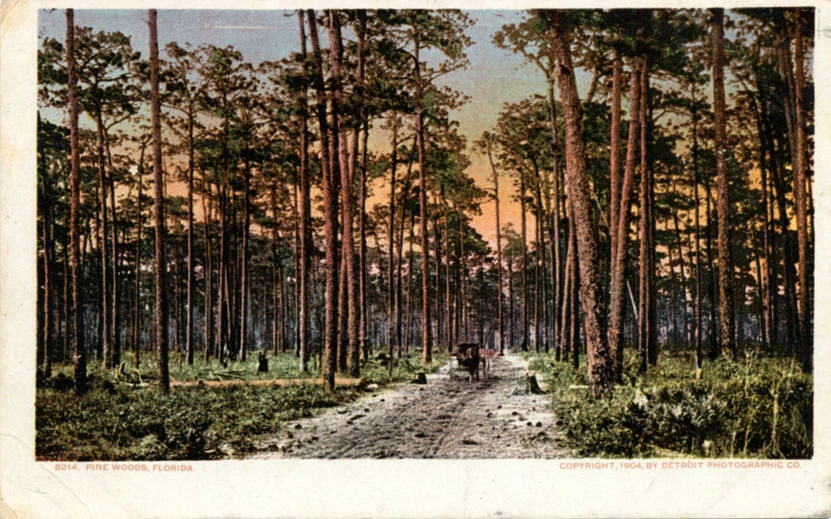
Tall Florida pine woods in color, a sand road running back through the trees under a soft evening sky, a single small cart on the road.
The pine this country is named for
This is what was out here. Flat, open Florida pine woods — the kind of country, and the kind of tree, the whole place is named for. Detroit Photographic Co., 1904; a representative Central Florida scene.

Drive south out of Orlando, past the airport, and you’ll go right through a place called Pine Castle. Nice name. Sounds like a subdivision — the kind of name somebody picks because it’s pleasant and means nothing. Except this one means something. There really was a castle out here. A man built it, out of pine trees, on the edge of a lake, and the town is still named after a house that’s been gone for well over a century.

So who builds a castle in the flat pine woods south of Orlando? And why would a place hang onto the name of a building almost nobody alive ever saw?

A castle, out of pine

The man was Will Wallace Harney, and he did not come here to build a castle. He came here heartbroken. Harney was a newspaper man up in Louisville — an editor, a poet people actually read — and in 1869 he packed up and made the thousand-mile trip down to Central Florida, mostly hoping the warm weather would help his wife, Mary. She died within days of getting here. He was left with an infant son and a piece of raw land on the west shore of Lake Conway.

A two-story wood-frame farmhouse on cleared ground, a man in a horse-drawn buggy stopped in front and a second man standing by the fence.
The kind of place people built out here
Not the castle — a neighbor’s place. A homestead in Orange County around 1885. No clear photograph of Harney’s own Pine Castle is known to survive; this is the sort of frame house people raised on cleared ground out here. State Archives of Florida.

What he did have was room. A homestead on the frontier meant acres of pine and palmetto and sand — far more than one grieving man and a baby could ever use. And out of that empty ground, Harney built something strange. Not a cabin. A house made from the pine growing right there on his land, with two turrets by the front door, walls of boards stood up vertical instead of laid flat so the whole thing looked taller than it was, and a two-story octagon room in the middle, twenty-four feet across, capped with castle peaks and a steep gothic roof you could pick out from any direction. He called it his Pine Castle.

“The house stands on the edge of a slope, a double-winged structure around a central octagon of two stories twenty-four feet in diameter, surmounted by castellated peaks and gothic pointed roof visible at every angle.” Will Wallace Harney, describing his own house

The one-man chamber of commerce

Harney never really made his living off that land. He made it with a pen. He kept writing — long dispatches back to big Northern papers like the Cincinnati Commercial, describing Florida to people who’d never laid eyes on it: the orange groves, the pine forests, the alligators, the whole warm strange wilderness of it. This was back when almost nobody up north had any picture of Florida at all, and Harney handed them one. People have called him a one-man chamber of commerce, which is about right.

And the house kept turning up in the writing. The Pine Castle. It became the most striking landmark between Orlando and Kissimmee — the thing you told a traveler to watch for. The name stuck, and then it spread. By 1879 the post office out there had taken it: Pine Castle. A few years later, so had the town. A whole community, named after one man’s odd pine house on a lake.

A steam locomotive pulling head-on into a small wooden depot, a few people standing on the platform beside the station.
The depot & post office that carried the name
How a name travels. The railroad station and post office at Pine Castle, around 1890, a locomotive pulling in. The post office took the name in 1879 and mailed it out to the rest of the world. State Archives of Florida.

Everybody out here built the same way

Here’s the part that outlasted the castle. The way Harney did it — get a piece of ground with room on it, then build the thing you actually want out of what’s standing there — that wasn’t just him. That was how the whole place got made.

An old hand-drawn plat map of lots along Lake Conway, labeled with family surnames, with the Harney homestead and a few streets marked in modern highlight.
Harney’s ground, cut into lots
The room, on paper. A plat of the Harney homestead along Lake Conway, its lots carrying the early family names. The streets out here still do — Randolph, for his wife’s people, and Wallace, his own middle name. Historical plat; the highlights and labels are a local historian’s. CitrusLAND (Richard Lee Cronin).

Families came down, claimed their acres, and cleared a little at a time. Orange trees went in first — the grove was the payday, a crop you could ship north in the dead of winter when the rest of the country was buried in snow. Then a house. Then a barn, a packing shed, a pen for a few head of cattle, a second little place out back when more family turned up. Nobody built it all at once. You built what you needed, when you needed it, because the room was there to keep adding on.

A man in a dark suit and hat standing in a young orange grove, a house set back among the trees and tall cabbage palms in the distance.
A house, a grove, and room to spare
The whole idea in one picture. A Central Florida home set back in its own orange grove, around 1875–1885 — house, trees, and open ground to keep building on. Robert N. Dennis stereoscopic views, New York Public Library. A representative grove of the era.

Citrus was the point of nearly all of it. Set out the trees, wait a few years for them to bear, and a grove paid you back every winter like clockwork. The last thing the growers needed was a way to get the fruit out, and in the early 1880s they got it: the South Florida Railroad pushed a line down through the pine, and suddenly the oranges could reach a market and the town had a reason to grow.

A man near the top of a tall wooden ladder leaned into a big orange tree, picking fruit, with filled baskets of oranges on the ground below.
The payday crop
What the room grew. A grower up a ladder picking oranges, filled baskets below — a Florida grove around 1880. “Scenes in Florida,” W. H. Cushing, St. Augustine. A representative grove of the era.

Orlando itself was barely more than a frontier town at this point — look at a bird’s-eye drawing of the city from 1884, the same stretch of years Pine Castle was taking shape a few miles south, and you’re looking at a place still mostly surrounded by woods and water.

An 1884 bird's-eye lithograph of Orlando, Florida: a grid of streets and small buildings ringed by groves, open fields, and lakes, with a title cartouche at the bottom center.
Orlando, 1884 — woods and water, mostly
The frontier next door. A bird’s-eye view of Orlando, Florida, 1884 — the little city a few miles north of Pine Castle, still hemmed in by groves and lakes. Drawn by J. J. Stoner; via Wikimedia Commons.
A small wooden railroad depot beside the tracks under a towering plume of smoke and steam, open country stretching out behind it.
The rail reaches the pine country
A reason to grow. The South Florida Railroad depot at Pine Castle, around 1881 — the line that finally gave the groves a way to ship north. State Archives of Florida.

The castle goes, the name stays

The castle itself didn’t last. By the time it burned, in 1894, Harney had long since drifted off — the grand house had stood empty and falling apart, and then one night it was gone. He moved up to Jacksonville to live with his grown son, and died there years later. The most striking landmark between Orlando and Kissimmee left behind almost nothing you could photograph.

Which is the strange thing about Pine Castle. The castle is the one part that didn’t make it. What survived was everything around it — the groves, the lanes, the family names on the street signs, and the name itself, fixed to a whole community that mostly never once laid eyes on the house it’s named for.

What’s still out there

A few of the old homes made it. Over on Randolph Avenue a frame house from 1885 is still standing, still lived in — white picket fence, wraparound porch, the kind of place raised back when the rule was plain: get your ground, build what you need, leave room to add on later.

A restored two-story 1880s wood-frame house painted sage green, with a wraparound porch and a white picket fence, under big shade trees.
Still standing on Randolph Avenue
What remained. The Noah H. Grady House, built in 1885, still lived in on Randolph Avenue in Pine Castle — one of the few homes from Harney’s town that’s still here. Photograph courtesy Orange County Property Appraiser.

Pine Castle isn’t the frontier anymore. Orlando grew down and wrapped all the way around it; the airport hums away just east; the groves are mostly subdivisions now. But drive the older streets along the Conway lakes and you can still feel it — the deeper lots, the places with a little ground left behind the house. The castle’s gone. The room it sat on never went anywhere.

Will Wallace Harney showed up here with nothing but grief and a piece of pine woods, and built the exact thing he wanted out of it. The town’s been doing some version of that ever since.

A present-day note · Orange Tiny Homes

The room out back is still the whole idea.

Strip away the turrets and Pine Castle is a plain Central-Florida story: somebody with a piece of ground, building the thing they actually wanted on it, and adding on as life asked them to. A grove. A barn. A second little place out back when family turned up. The room was never decoration — it was what let people build what they needed, when they needed it.

That instinct still pays, and the thing people build out back now has a name — an ADU, an accessory dwelling unit. That’s what we do. A granny flat so a parent can live close with their own front door. A guest house. A rental out back that helps carry the mortgage. A tiny home in the far corner of the lot. Harney’s move, basically — build what you want on the room you’ve got — just with a kitchen, a bathroom, and a permit.

And you don’t need acreage to do it. All across the greater Orlando area — the roomier lots out toward Conway and the rural edges, sure, but plenty of ordinary yards closer in too — the space is already there. What actually decides it comes down to your own address:

The real answer to “is there room out back for this?” isn’t a guess — it’s a handful of facts about your lot. That part we can check for you.

Put in your address and we’ll pull what your parcel allows and tell you whether a granny flat, guest house, rental, or tiny home actually fits — before you spend a dollar on drawings.

Start the ADU Fit Check→
Sources & Photo Credits

On the history

Where sources differ: the house-build date is given as 1873 by most accounts and 1874 by a few; this page uses “about 1873.” Harney’s birthplace was Indiana, but his adult life and newspaper career were in Louisville, Kentucky, and he came to Florida from Kentucky — one secondary account mistakenly says “Ohio,” which the biographical records do not support. The Harney self-description of the house is quoted as it appears in the marker and local-history accounts. No clear photograph of the Pine Castle house itself is known to survive; the homestead and grove images on this page are clearly labeled as representative Central Florida scenes of the same era, while the Pine Castle depot and the Grady House are specific to the community. Full notes are in source-record.md beside this page.

Photographs & documents

  1. Florida pine woods (hero) — a sand road through tall pines, color postcard, 1904. Detroit Photographic Co., via Wikimedia Commons (Newberry/CARLI). A representative Central Florida flatwoods scene. File: florida-pine-woods-1904. commons.wikimedia.org
  2. Orange County homestead — the John Anderson homestead, Orange County, Florida, circa 1885; a two-story frame house with a family and buggy. State Archives of Florida, Florida Memory (RC07297). A representative Orange County homestead of the era, standing in for the frame houses raised on cleared ground near Pine Castle. File: john-anderson-homestead-orange-county-c1885. floridamemory.com/items/show/30413
  3. Railroad station and post office, Pine Castle — a locomotive pulling into the depot, circa 1890. State Archives of Florida, Florida Memory (N039345); Savannah, Florida & Western Railway. Specific to Pine Castle. File: pine-castle-station-post-office-c1890. floridamemory.com/items/show/147608
  4. Plat of the Harney homestead — a plat of the lots along Lake Conway in the Harney homestead area, from the 1890s, annotated by a local historian (the “Harney Homestead” label and colored streets are modern). Via CitrusLAND (Richard Lee Cronin), “Pine Castle’s 19th Century Secret.” File: harney-homestead-plat-1891. citruslandfl.blogspot.com
  5. Residence and orange grove, Enterprise, Florida — a man in a young orange grove with a house set back among the trees, stereoview cropped to one frame, circa 1875–1885. Robert N. Dennis collection of stereoscopic views, New York Public Library, via Wikimedia Commons. A representative Central Florida grove of the era. File: enterprise-residence-orange-grove-c1880. commons.wikimedia.org
  6. Picking oranges — a grower up a ladder picking oranges with filled baskets below, stereoview cropped to one frame, circa 1880. “Scenes in Florida,” W. H. Cushing, St. Augustine; New York Public Library, via Wikimedia Commons. A representative Florida grove of the era. File: picking-oranges-grove-c1880. commons.wikimedia.org
  7. Bird’s-eye view of Orlando, 1884 — a lithograph of Orlando, Florida, drawn by J. J. Stoner (Beck & Pauli), 1884. Via Wikimedia Commons. The frontier city a few miles north of Pine Castle, the same years Pine Castle was taking shape. File: orlando-birds-eye-1884. commons.wikimedia.org
  8. South Florida Railroad depot, Pine Castle — the depot beside the tracks under a plume of smoke, circa 1881. State Archives of Florida, Florida Memory (N036979). Specific to Pine Castle. File: pine-castle-south-florida-depot-c1881. floridamemory.com/items/show/146264
  9. Noah H. Grady House — a surviving 1885 frame house on Randolph Avenue in Pine Castle, present-day color photograph (the original carries an Orange County Property Appraiser courtesy watermark across the top, cropped here). Courtesy Orange County Property Appraiser, via CitrusLAND. File: grady-house-pine-castle-surviving-2010s. citruslandfl.blogspot.com

Original downloads and the full research record are kept alongside this page in assets/images/originals/ and source-record.md. Several images are genuine photographs of the right era and region used to show what Pine Castle’s woods, homesteads, groves, and rail connection looked like; each is labeled above as specific to Pine Castle or representative. No historical image was altered in a way that changes its content; the two stereoviews were cropped to a single frame and lightly adjusted for tone, and the courtesy watermark bar was cropped from the Grady House photograph. The Polaroid frames and handwritten notes are CSS added around the images, never onto them.