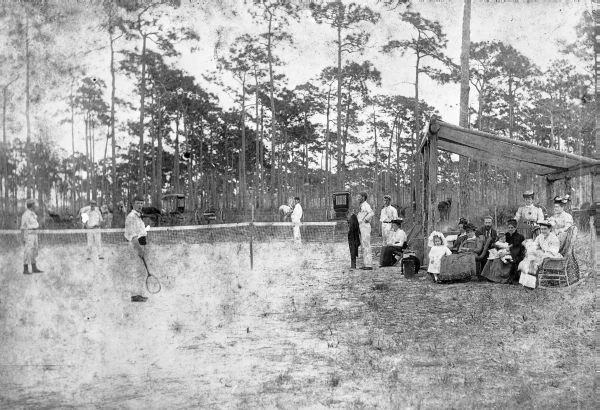
Men in tennis whites, on a grass court, with a crowd in their good clothes watching from the shade of a clubhouse. Nothing strange about that — except for where it is. This is the Florida scrub around 1900, better than twenty miles southeast of a small Orlando, out where the pavement gave up and the palmetto took over. So what is a proper English tennis club doing out here, at the far edge of nowhere?
The answer is the reason this corner of Florida exists at all. There was room — miles of it, cheap — and somebody from a long way off decided that room was worth a fortune.
The far side of nothing
Narcoossee sits on the east shore of East Lake Tohopekaliga, in what’s now eastern Osceola County — though when this story starts there was no Osceola County yet. It was all east Orange County then, and this was its back acreage: flat, wet, pine and palmetto, more water than road.

Being that far out was the whole point. Land nobody else wanted was land you could buy by the square mile, and in 1883 that’s exactly what a London solicitor named Arthur Fell did — 12,640 acres of it, enough to lose a small city in, bought in a single stroke. He never meant to farm it himself. He sent for his younger brother.
The pitch
Nelson Fell was a trained engineer, twenty-seven and working a mine out in Colorado, when his brother’s letter reached him. He came east, took a partner named Davidson, and in the fall of 1884 the two of them surveyed and platted about 2,000 acres along the lake into small farms. They gave it a Creek word for black bear: Narcoossee.
Then they advertised, hard, in England. The pitch was simple and almost true: buy a few acres here, set out orange trees, wait for them to come into fruit, and collect something like ten thousand dollars a year for the rest of your life. In the 1880s that wasn’t a living. That was a fortune — a country house and a servant, sent over from a Florida swamp.
The land was cheap because it was empty. The promise was that the emptiness was temporary — that you’d fill it with orange trees and money.
And they came. Englishmen with a little capital and a lot of faith in the brochure stepped off the boat and headed for a place most of their countrymen couldn’t have found on a map.
A little England in the palmetto
What they built out here is the part that still surprises people. Given all that room, the colonists didn’t just plant groves — they rebuilt the life they’d left. A lawn tennis club. A church. A schoolhouse in 1886, older than the county around it. And a hotel, the Runnymede, named for the English meadow where the Magna Carta was sealed — a showy three-story retreat dropped into the pine flats as if it had wandered off from a seaside town.

There was a general store with a post office, a railway depot a few years on, streets laid out and graded by mule team. For a decade this wasn’t a struggling outpost — it was a going concern that happened to be a long way from everything, with Englishmen playing tennis on a Saturday and oranges ripening on the money-trees out back.

You built what you needed out here
Having room wasn’t scenery; it was the method. When the nearest help was a long buggy ride off, you didn’t send out for things — you put up another building. One family’s place tells it plainly. When Colonel William Cadman’s people arrived from England in 1888 and bought their grove, what they bought came with a main house, a separate kitchen set apart from it, a stable, a buggy house — and a small set of quarters out back where the grown sons slept.

Those sons built a packing house around 1890 and turned the family grove into a business. The fruit went into wrappers printed Radclyffe-Cadman Bros., Florida, under a seal of a crowned stork’s head, barreled up and shipped all the way back to England — and it arrived, the family liked to say, as fresh as the day it left Narcoossee.
When the railroad finally reached the colony on the nineteenth of July, 1889, the town threw itself a party worth the wait. A noon train came down from Sanford with the Orlando Cornet Band aboard, and the feast ran to — this is on the record — “three beeves, two sheep and two hogs barbecued in Jack Evans’ well known style.” The day was declared a success.

The two nights that ended it
Here’s the thing the brochure never mentioned: the room was the easy part. The oranges were the gamble, and Florida collects on that gamble about once a generation.
It came due in the winter of 1894 and 1895. Two freezes, roughly six weeks apart — the second one catching the trees just as they’d pushed out tender new growth after the first. Groves that had taken ten years to raise were killed to the ground in two nights. The money-trees were gone, and with them the whole premise that had been printed in those English newspapers.

Most of the English didn’t stay to try again. A grower who’d come for an easy fortune had little reason to spend years nursing a dead grove back, and many simply went home, or pushed farther south in Florida to start over on warmer ground. A drought in 1908 thinned the holdouts further.
Then in 1910 Nelson Fell did the thing he knew how to do — he found more room. He put together a tract many times the size of Narcoossee down in Indian River County and started a new colony, Fellsmere, and took a good share of the remaining settlers with him. The church that the colonists had spent years building, finishing it only in 1898 after a bank failure stalled the work, lost its congregation. In 1930 they took it apart and hauled it to St. Cloud, where it became part of another.

What the room kept
But not everyone chased the next fortune. The Cadmans stayed, kept growing fruit, and did well at it — the business ran on under the family name into the next century. And the land itself did what land out here does: it stayed big, and it stayed quiet, long after the colony that named it had scattered.

You can still read the colony in the names — Fells Point, Fells Cove, Fells Lane, all of them the Fell family, still on the map. And you can walk through the rest of it: the Cadman home, its detached kitchen, the packing house, and the little bachelor’s quarters where the sons slept were saved and moved to Pioneer Village at Shingle Creek, where they stand together the way a working Florida homestead used to — a main house, and everything else a family needed, built out around it.

The tennis whites are gone, and so are the money-trees and the English newspapers that sold them. But stand out by that lake today and the thing that started all of it is the one thing still obviously here: room, out past the edge of the city, waiting for somebody to decide what to build on it. That hasn’t changed in a hundred and forty years. Only the price of an acre has.