Drive into old Windermere and the first thing that happens is the light goes soft. Live oaks close over the road, the pavement gives way to brick and then to sand, and the lots open up wide and green on water you can see clear to the bottom. It looks like it was always meant to be this calm. It was not planned by the people you would guess, and it almost did not get built at all.
Start with the name, because the name is the first clue that something odd happened here. Windermere is a lake in the north of England. There is no English lake district in Orange County. So who looked at a scrap of grove land between a chain of Florida lakes and reached all the way across an ocean for a name?
The men who named it had seen the English one
An Englishman named Joseph Hill Scott bought land on the west shore of a big lake out here in the mid 1880s. His son Stanley settled it and called the whole place Windermere, after the lake back home. Another Englishman, John Dawe, drew the town out on paper in 1887, laying streets between the water. A post office opened the next year. For a genteel English lake colony dropped into the Florida scrub, it was a lovely idea on paper.

Pull up that 1890 survey map and you can see what the town was actually offering. Not a crowded resort. Room. A whole necklace of spring lakes with a thin scatter of names along the banks, and open country in every direction. The little word “Windermere” is already printed by a rail stop, and the Scott name sits right on Lake Butler where the family had settled. Everything around it is empty. The emptiness was the product.
The money was oranges, and the lakes kept them alive

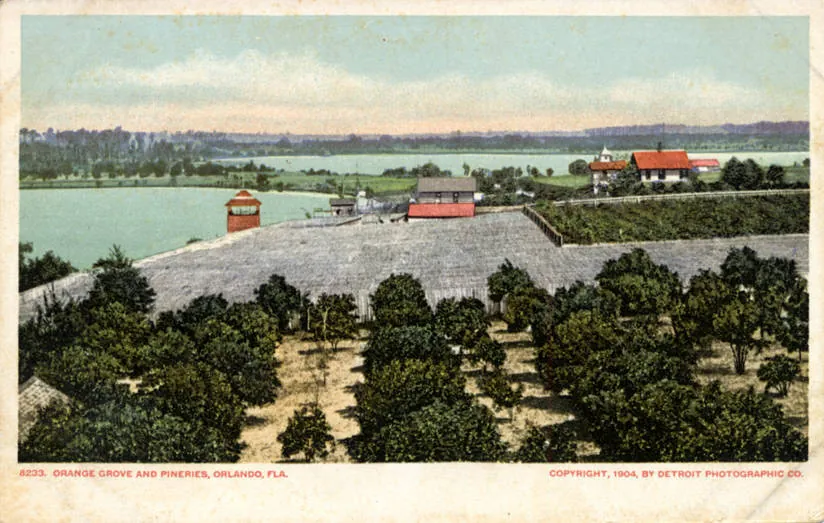
What paid for all that room was citrus. This was grove country, the same high sandy ridges west of Orlando where anyone with a few acres and some nerve planted orange trees and waited to get rich on them. People came for the land because the land grew fruit, and for a long run of years the fruit was good money.
The lakes were not just scenery. A big body of water soaks up the day's heat and lets it back out slowly after dark, so a grove ringed by lakes could ride out a cold night that stripped the trees a few miles inland. The growers knew it. That is why the groves crowded up against the Butler Chain and spread back from the shore, and why the most valuable ground out here was the ground closest to the water.
Then the English town quietly stalled
Here is the turn. The elegant English colony did not really take. The post office that opened in 1888 closed again in 1901. For a couple of decades Windermere stayed what the map showed, a thin scatter of grove families on the lakes, more idea than town. Somebody still had to actually build the place. And the people who finally did were not English at all.

They came down from Ohio. A man named Cal Palmer put up a little office on Main Street in 1911, a gray clapboard box with a deep porch that is standing to this day. He and a Dr. J. Howard Johnson ran the Windermere Improvement Company, which is the old polite name for the outfit that sells you a lot and talks up the town. They had fallen for the place the way people still do, for the clean lakes, the orange groves, and the pine timber standing thick on the ridges.
By 1925 there were finally enough of them to make it real, and three Ohio men, Palmer, Johnson, and Howard Lyon, signed the papers that made Windermere an actual town. Every one of them took a turn as mayor over the years. The first store in the little downtown had been run by Ralph and Minnie Kline a decade earlier. Piece by piece, the paper town became a real one.
They built it the way you build with room to spare

And they built the way a town builds when it has land and no hurry. A one room schoolhouse had already gone up back in 1890, a little board-and-batten box now swallowed in oaks. The women of the town ran a club and raised their own hall in the 1920s, and that building became the town hall, which it still is.

A school, a hall, a store, a church. One useful building at a time, each on its own patch of ground, none of them shoved up against the next. Nobody was trying to fit the most people onto the least land. They had come for the opposite of that.
The name on the water gives the newcomers away
Somewhere in all that building, the water picked up its names. The bay that old Windermere wraps around, the one the houses of Metcalf Point look out on today, is Wauseon Bay. Wauseon is not a Florida word. It is a small town up in Ohio, and the men who were busy turning this place into a real one had come from up that way.
The records I turned up do not quite spell out which of them pinned the name to the water, so I will leave it where the evidence leaves it: a piece of Ohio, set down on a Florida lake by people who were a long way from where they grew up. You can stand on Wauseon Bay today and the name is the one plain fingerprint of the Midwesterners who made the town.
The whole trick out here was to get a lot of room, and then have the nerve not to fill it.
What they chose not to do

What is easy to miss about Windermere is the thing it did not do. It had every excuse to pave over and pack in, the way the rest of Orange County eventually did. It did not. The town kept its lots wide, left a lot of its side streets as plain sand so the oak roots could breathe, and let the live oaks grow until they met over the road. It still puts real effort into guarding those trees.
So that canopy over Metcalf Point is not landscaping. It is the leftover of a decision, made a hundred years ago by people who would rather have the shade and the space than one more house on the lot.
Which leaves you with a town that makes no geographic sense on paper. An English name for a lake in England. A bay named for a town in Ohio. A feel that belongs to neither. What it actually runs on is the oldest idea in this part of the county: get some room, and leave most of it open. Stand on a dock on Wauseon Bay at dusk, the oaks going dark behind you and the water still holding the day's warmth, and you are looking straight at the thing every one of those people, English and Ohioan both, really came all this way to get.


