Keene’s Pointe, Orlando, Florida  ·  A Local History

The Orange Picker Who Ended Up Owning the Point


R. Dolph Keene started in citrus on a ladder, picking fruit that belonged to other men. He spent the next sixty years getting more room — grove by grove — until a whole point of land on the Butler Chain was his. The gate, the golf course, and the public boat ramp out there still carry his name.

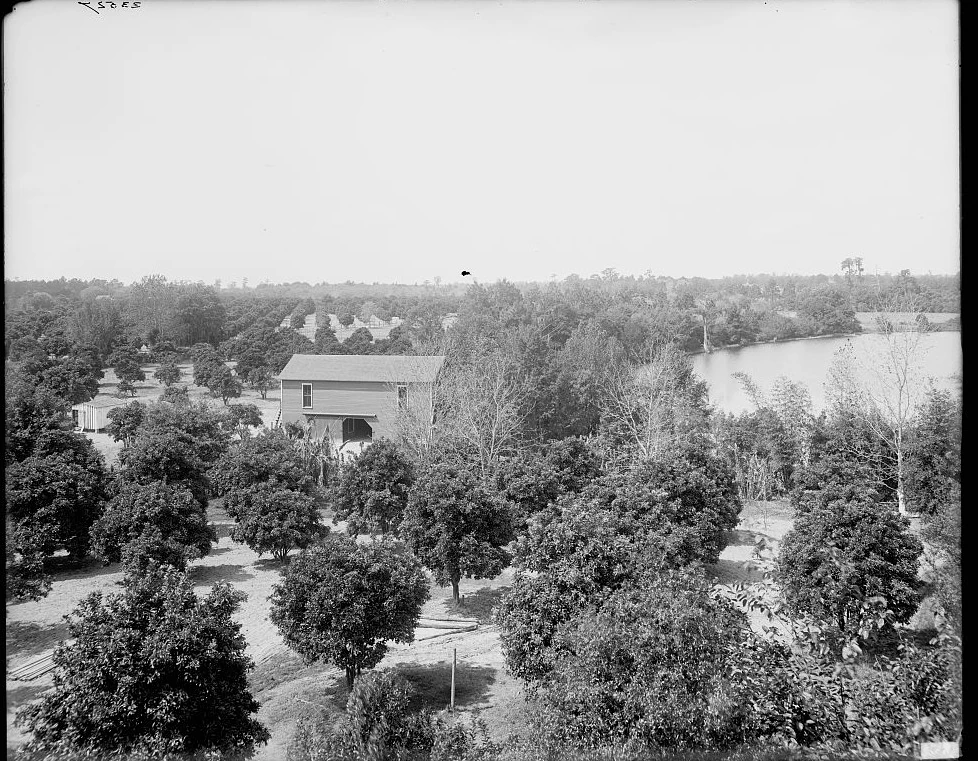
An elevated view across rows of orange trees down to a lake, a tall packing shed among the trees and more groves running to the horizon.
Groves down to the water, near Orlando — about 1900
This was the whole game. Orange groves running down to a lake near Orlando around 1900 — a packing shed in the trees, water on one side, grove to the tree line. Detroit Publishing Co., Library of Congress. A representative Central Florida grove-on-the-water of the era.

There’s a guardhouse out past Windermere, on a point of land that pushes into the Butler Chain of Lakes, and you don’t drive past it unless somebody inside is expecting you. Behind it: a Jack Nicklaus golf course, some of the pricier houses in Orange County, docks on clear water. The name on the gate is Keene’s Pointe. And Keene wasn’t a golfer, or a developer, or anybody’s idea of old money.

He was a man who started out picking other people’s oranges off a ladder. So how does a grove hand’s name end up on one of the most guarded gates in the county — and on a public boat ramp right next to it?

A boy, a ladder, and the worst winter anyone could remember

Rodolphus Dolph Keene was born in 1885, and the way the story gets told, he was in the groves as a boy near Kissimmee — working his father’s trees when the cold came down the winter he was ten. That winter has a name. On the night after Christmas in 1894 a freeze killed the fruit across Central Florida, and when growers thought they’d taken their hit, a second freeze in February of 1895 killed the trees themselves. People still call it the Great Freeze, and it broke the back of the citrus business up here.

A bare, stripped orange grove on flat open ground after a hard freeze, trees without leaves or fruit, a crate sitting in the empty rows.
After the Big Freeze — 1895
What a boy would’ve seen. A Central Florida orange grove stripped bare after the freeze, photographed in May 1895. “Orange Grove at Citra, Fla. after the Big Freeze.” USDA National Agricultural Library, Special Collections. A representative Central Florida freeze scene.

Plenty of families left Florida for good after that. Keene didn’t. He stayed in oranges, and he learned the business the long way — from the bottom. By 1907 he was working groves for Dr. P. Phillips, the Orlando grower who would become the biggest citrus name in the region and one of the men who figured out how to can and ship the state’s orange juice. If you wanted to learn how Florida citrus actually worked — the picking, the grading, the shipping, the money — there were worse places to stand than in Dr. Phillips’ groves.

He didn’t start with room. He started with a ladder in another man’s grove — and spent the rest of his life ending up with more ground than whoever owned it before him.The shape of the whole story

The year he stopped working other men’s fruit

The jump from laborer to owner is the hinge of the thing. In 1922 Keene and a partner, Barney Dillard Jr., bought a packinghouse of their own over in Eustis. That’s the moment the fruit stops belonging to somebody else. A grove is a slow bet — you plant trees and wait most of a decade before they really pay — but a packinghouse is the choke point every grower in the district has to come through to get paid. Own the packinghouse and you’re no longer the man on the ladder. You’re the man the ladders work for.

A man near the top of a tall wooden ladder leaning into a big orange tree to pick fruit, with filled baskets of oranges on the ground below him.
Where everybody started
The bottom rung, literally. A grower up a ladder picking oranges, filled baskets below — a Florida grove around 1880. “Scenes in Florida,” W. H. Cushing; via the New York Public Library. A representative grove of the era, the work Keene came up through.

In 1933 he moved the whole operation to Winter Garden, west of Orlando, and he never left. He put up a packinghouse there and then kept building onto it — which is the part that tells you who he was. A man who’d come up picking fruit didn’t stop at one shed. He helped start the Winter Garden Citrus Products Cooperative and ran it as its chief executive into the 1960s, and the plant kept getting bigger: from plain single-strength juice to frozen concentrate, until it was one of the largest concentrate plants in the state.

That last part is quietly the revenge on 1895. The freeze that ruined his childhood groves destroyed fruit because fresh fruit can’t wait. Juice you can freeze into concentrate doesn’t rot on the dock — it keeps, and it ships to a cold city in January. The boy who watched a freeze take everything spent his adulthood helping build the thing a freeze couldn’t touch.

A colorful orange-crate label reading Sherlock's Delight, Florida Citrus, with a cartoon detective in a deerstalker cap holding a magnifying glass over a branch of oranges.
The brand went on the box
Fruit sold by its name. A Florida orange-crate label, “Sherlock’s Delight,” Holmes Fruit Co., Tampa, around the 1930s. Via Wikimedia Commons. A representative Florida citrus label of the packinghouse era — every shipper had one.

The point on the lakes

Somewhere in those years Keene did what a Florida citrus man with money did: he got himself room. Grove land, out on a point that reached into Lake Tibet-Butler, down at the lower end of the Butler Chain near Windermere. It was good ground for the same reason the whole chain was good ground — big water holds its heat overnight and keeps the grove around it a few saving degrees warmer when the cold comes. After 1895, every grower in Central Florida knew exactly what that was worth.

A wide color view down a sandy grove lane at harvest, pickers up ladders on both sides, field crates of oranges stacked along the row and a small crawler tractor in the distance.
Picking time, a Florida grove
What the room produced. “Orange Picking Time in Florida” — a mid-century color postcard of a grove at harvest, ladders and field crates down the row. Curt Teich & Co.; via Wikimedia Commons. A representative Florida harvest scene.

And the work it took hadn’t changed much since Keene was the boy on the ladder. Somebody still climbed up into every tree. A grove was only ever worth what the crews could get off the branches and into the field crates before it spoiled — which is the other reason a man who owned the packinghouse and the concentrate plant wanted to own the grove too. Control the whole line, from the tree to the frozen can, and no single bad winter could end you.

A posed photograph of three citrus workers standing with picking buckets and a crate in front of a studio backdrop.
The hands that brought it in
Somebody picked every orange. Three Central Florida citrus workers with their buckets, around 1890. RICHES of Central Florida, University of Central Florida. A representative citrus-labor scene of the era.

None of this was unusual, exactly — it was just how this corner of Florida got built, and had been since before the groves. Families came down, claimed their acres out in the pine and palmetto, and added on a piece at a time: a house, then a barn, then a packing shed, then more grove when there was money for more trees. The map of Orange County was a record of people getting room and putting things on it. Keene did the same thing, at the scale a packinghouse and a concentrate plant will buy you.

An 1890 map of Orange County, Florida, a grid of townships and sections, lakes scattered across the western half, and the surnames of landowners printed on their parcels.
Orange County, 1890 — the room, carved into names
Room, on paper. A map of Orange County from 1890 — townships and sections, the chain of lakes down the west side, and the names of whoever had claimed their ground printed right on their parcels. Fries & E. W. Smith & Co., Library of Congress.

Why the groves gave way

The citrus didn’t last out there forever. More hard freezes rolled through Central Florida in the decades after the war, and each one chipped at the groves. By the time Orlando started sprawling west toward the lakes, grove land this close to a growing city was worth more with houses on it than with trees — and lakefront grove land most of all. The old point was ground waiting for its next use.

It came in the late 1990s. A developer, Castle & Cooke, took the former grove and timber land on the point and turned it into a gated community wrapped around a golf course — the Golden Bear Club, a Jack Nicklaus signature course that opened in 1999. The gate went up; the custom houses went in; the docks reached out into the Butler Chain. And the name they kept for the whole thing was the name already on the land. Keene’s Pointe.

What’s still out there with his name on it

Here’s the part that would’ve pleased a man who started on a ladder. The gate isn’t the only thing carrying his name out there. Right next to it, on the water, is R.D. Keene Park — fifty-some acres the county runs, with ball fields and a boat ramp that’s one of only a couple of public ways onto the whole Butler Chain of Lakes. A grove hand’s name ended up on the gate the public can’t use, and on the ramp anybody can back a trailer down.

A present-day wooden boardwalk curving through a shaded Florida hammock of oaks and ferns at Tibet-Butler Preserve.
The wild edge, Tibet-Butler Preserve — today
The ground that stayed ground. The boardwalk at Tibet-Butler Preserve, just outside the Keene’s Pointe gate on the lake named Tibet-Butler, 2016. Via Wikimedia Commons. A modern photograph.

The trees are mostly gone. The lakes are not. The Butler Chain is still clear water, still the reason anyone wanted this point of land in the first place — the same big water that once kept Keene’s oranges from freezing now keeps the view from a back lawn and floats the boats off his ramp.

A present-day view of a calm Butler Chain lake at Windermere, tall palms and shade trees along a grassy shoreline.
The Butler Chain today, Windermere
The thing that never moved. A Butler Chain lake at Windermere today — the open water that made this point worth owning in the first place. Present-day photograph, via Wikimedia Commons.

A boy stood in a grove near Kissimmee the winter everything froze, and instead of leaving he spent the next sixty years getting more room than the last man had — a packinghouse, then a bigger one, then a plant that could freeze the juice a freeze couldn’t ruin, and finally a point of land on the water. He didn’t keep any of it in the end. But the name stuck to the ground, the way it does when somebody holds a piece of Florida long enough.

A present-day note · Orange Tiny Homes

The room was always the point.

Take the gate and the golf off of Keene’s Pointe and what’s underneath is the oldest Central-Florida habit there is: get a piece of ground with room on it, and put the thing you need out there yourself. Keene did it with groves and sheds and a concentrate plant. The homesteaders on that 1890 map did it a barn and a back cottage at a time. Nobody finished their place in a season — they added on as life asked them to, because the room was sitting right there to add onto.

That instinct still pays, and the thing people build out back now has a name — an ADU, an accessory dwelling unit. That’s what we do. A granny flat so a parent can live close with their own front door. A guest house. A rental out back that helps carry the mortgage. A tiny home in the far corner of the lot. Keene’s move, basically — put what you want on the room you’ve got — just with a kitchen, a bathroom, and a permit.

And you don’t need a point on the Butler Chain to do it. All across the greater Orlando area — the roomier lots out toward Windermere and Gotha, sure, but plenty of ordinary yards in Conway, Pine Hills, Azalea Park and unincorporated Orange County too — the space is already there. What actually decides it comes down to your own address:

The real answer to “is there room out back for this?” isn’t a guess — it’s a handful of facts about your lot. That part we can check for you.

Put in your address and we’ll pull what your parcel allows and tell you whether a granny flat, guest house, rental, or tiny home actually fits — before you spend a dollar on drawings.

Start the ADU Fit Check→
Sources & Photo Credits

On the history

Where sources differ, or detail is thin: the exact years and parcels by which Keene assembled the grove land on the point are reported only in secondary real-estate histories and are given here in general terms rather than as pinned dates. Development-era land transfers around Windermere are also reported variously (some accounts route nearby grove land through a 1984 sale to Arnold Palmer, which belongs to the neighboring Isleworth story, not this one); this page stays with the documented fact that the community and the county park both carry Keene’s name because it was his grove land. Keene’s childhood role in the 1895 freeze is drawn from the Florida Citrus Hall of Fame biography; the broad freeze facts are from the Orange County Regional History Center. Acreage and homesite counts for the modern community vary by source (roughly 950–1,200 acres; about 1,050–1,100 homes across some 14–18 villages) and are given as ranges. Full notes are in source-record.md beside this page.

Photographs & documents

  1. Orange groves down to a lake near Orlando (hero) — an elevated view of orange groves running to a lake, Orlando, Florida, circa 1900. Detroit Publishing Co., Library of Congress Prints & Photographs Division. A representative Central Florida grove-on-the-water of the era. File: grove-on-the-water-orlando-c1900. loc.gov/item/2016809289
  2. Orange grove after the Big Freeze, 1895 — a stripped, dead grove after the freeze, “Orange Grove at Citra, Fla. after the Big Freeze, May 23, 1895.” USDA National Agricultural Library, Special Collections. A representative Central Florida freeze scene. File: grove-after-the-big-freeze-1895. nal.usda.gov
  3. Picking oranges, c.1880 — a grower up a ladder picking oranges with filled baskets below, one frame of a stereoview. “Scenes in Florida,” W. H. Cushing, St. Augustine; New York Public Library, via Wikimedia Commons. A representative Florida grove of the era. File: up-the-ladder-picking-oranges-c1880. commons.wikimedia.org
  4. Three citrus workers, c.1890 — three Central Florida citrus workers with picking buckets. RICHES of Central Florida, University of Central Florida. A representative citrus-labor scene of the era. File: citrus-workers-with-buckets-c1890. richesmi.cah.ucf.edu
  5. “Sherlock’s Delight” orange-crate label, c.1930s — a Florida orange-crate label, Holmes Fruit Co., Tampa, Florida. Via Wikimedia Commons. A representative Florida citrus label of the packinghouse era (not one of Keene’s own brands). File: sherlocks-delight-florida-label. commons.wikimedia.org
  6. “Orange Picking Time in Florida” — a mid-century color (linen) postcard of a Florida grove at harvest, pickers on ladders and field crates down the row. Curt Teich & Co.; via Wikimedia Commons. A representative Florida harvest scene; cropped from the postcard’s own border. File: orange-picking-time-florida. commons.wikimedia.org
  7. Map of Orange County, Florida, 1890 — townships, sections, lakes, and landowners’ names, drawn by J. O. Fries and published by E. W. Smith & Co., Philadelphia, 1890. Library of Congress Geography & Map Division, via Wikimedia Commons. File: orange-county-map-1890. loc.gov/item/2012592407
  8. Tibet-Butler Preserve boardwalk, 2016 — a present-day photograph of the boardwalk at Tibet-Butler Preserve, beside Keene’s Pointe on Lake Tibet-Butler. Via Wikimedia Commons. Clearly a modern image. File: tibet-butler-boardwalk-today. commons.wikimedia.org
  9. The Butler Chain today — a present-day photograph of a Butler Chain lake at Windermere (Lake Down Park). Via Wikimedia Commons. Clearly a modern image. File: butler-chain-lake-today. commons.wikimedia.org

Original downloads and the full research record are kept alongside this page in assets/images/originals/ and source-record.md. Several images are genuine photographs of the right era and region, used to show what Keene’s groves, the freeze, the labor, and the lakes looked like; each is labeled above as specific to its subject or as representative. No historical image was altered in a way that changes its content — the “Orange Picking Time” postcard was cropped to remove its printed border and caption, the 1890 county map and the hero were cropped at the edges and downscaled, and the Polaroid frames and handwritten notes are CSS added around the images, never onto them.