Keene’s Crest, Orlando, Florida  ·  A Local History

Before the Gates, It Was All Open Range


For most of its history the land west of Orlando wasn’t fenced at all. Cattle wandered where they liked, across everybody’s ground, and Florida held onto that longer than any other state, until a law in 1949 finally made every family draw a line around what was theirs.

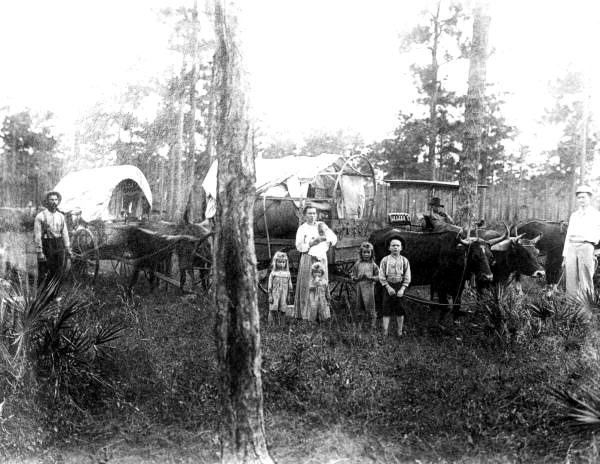
A pioneer family standing beside a canvas-topped wagon and a yoke of oxen among tall, widely spaced pine trees.
Orange County, room enough to get lost in
All of this was open. A pioneer family and their ox-wagon in the pine country of Orange County, around 1912. Land you did not own was still land your animals could use. State Archives of Florida, Florida Memory.

Here is a thing about this land that sounds made up. For about a hundred years, if a neighbor’s cow walked onto your property and ate your garden flat, that was your problem, not his. The law put the burden on you. If you wanted the cow kept out, you built the fence. Nobody was required to fence a cow in.

So picture the whole west side of Orange County running that way at once. Not a patchwork of pastures. One big shared range, cattle drifting across it wherever the grass and water were, and the lines on a deed meaning almost nothing to the animals. That was normal out here. It was normal for longer than almost anywhere in America.

Which raises the obvious question. How does a place work when half of what walks across your yard belongs to somebody else?

The county was a commons

Before the orange groves, before the lakeside houses, the sandy flatwoods west of Orlando were range and homestead farmland, and the two went together. A family would take a piece of ground, put up a house, and plant a little cotton or sugar cane or sweet potatoes. The hogs ran loose in the woods. The cattle ran loose on the range. You ate what you fenced in and sold what you could round up.

A wood-frame farmhouse with a porch, a horse and buggy hitched at a fence out front, and a family posed in the yard.
A homestead, and the ground around it
House in front, range out back. A homestead in Orange County, around 1885: a frame house, a buggy, and open land behind it. The fence by the road kept animals off the yard, not in it. State Archives of Florida, Florida Memory.

The names on the early west-Orange ground were families like the Hudsons, the Ropers, the Sims. They raised a little of everything and a lot of cattle, because cattle were the one crop that fed themselves on land nobody had to buy. The range cost nothing to use. That was the whole trick of it.

A loose herd of dark cattle moving across open grassland with riders at the edges and a tree line behind.
Nobody’s pasture, everybody’s cattle
Grass that belonged to no one. Cattle moved across open Florida range, around 1900. On a shared range the herd went where the feed was, deed lines or not. State Archives of Florida, Florida Memory.

And the cattle out there were not the fat, slow animals you picture. They were small, lean, big-horned, and more than half wild, descended from the Spanish cattle that had been loose in Florida since the fifteenth hundreds. They could live on palmetto scrub and swamp grass and shrug off the heat and the ticks that killed softer breeds. People called them scrub cattle, or cracker cattle. Getting them to market was less like herding and more like hunting.

The men who hunted cattle

That is not a figure of speech. The men who worked these herds were called cow hunters, because at roundup they rode into the palmetto and the pine and hunted the half-wild cattle back out of the brush. Their tool was not a lasso. It was a braided leather whip, sometimes longer than a man is tall, and they cracked it over the herd to move it. The sound carried like a rifle shot.

A cowboy sitting a small horse in open pine flatwoods, with cattle scattered in the grass behind him.
A cow hunter at the roundup
Hunting cattle out of the scrub. A Florida cow hunter on a marsh tackie pony at an open-range roundup near Fort McCoy, central Florida, around 1910. State Archives of Florida, Florida Memory. Shown for the kind of work done on the range all across the region.

By tradition, that crack is where the word “cracker” came from, the whip-cracking cowmen of the Florida woods. It is a good story, and it may even be true, but nobody is really certain; the word has older and muddier roots that historians still argue about. What is not in doubt is the whip, the dogs, and the half-wild cows. The look of it stuck so hard that a visiting Northern artist built an entire magazine piece around it.

A painting of a lone cowboy on horseback with two dogs, palmetto and palms around him, captioned 'A Cracker Cowboy.'
“A Cracker Cowboy,” 1895
The picture the rest of the country saw. Frederic Remington’s “A Cracker Cowboy,” drawn for Harper’s in 1895. An outsider’s romantic image of the Florida cowman, whip, dogs, and all. State Archives of Florida, Florida Memory. A period illustration, not a photograph.

Every family of cattle carried a mark so you could tell yours from your neighbor’s out on the shared range. The brands traced straight back to the Spanish, strange little figures burned into a hide, a whole private alphabet of ownership for animals that otherwise answered to no one.

A hand-drawn chart of old Spanish cattle-brand symbols, captioned 'Old Spanish Brands.'
Who owns which cow
Ownership, one mark at a time. A chart of old Spanish cattle brands, around 1900. On an open range, the brand was the only proof a loose cow was yours. State Archives of Florida, Florida Memory.

Where the cattle went

Rounded up, the herds went south. Cow hunters drove them down through the center of the state to a sandy spit on the Gulf called Punta Rassa, penned them by the thousands, and loaded them onto schooners bound for Cuba, which was hungry for Florida beef and paid for it in Spanish gold. Captains are said to have poured the coins out on the wharf and counted by the head.

Working cattle and oxen beside a rough log building, a cart to one side, people standing near the animals.
Headed for the boats, Punta Rassa
The end of the drive. Florida range cattle at Punta Rassa, around 1900, the Gulf shipping point where herds were loaded for Cuba. State Archives of Florida, Florida Memory.

The man who ran that trade bigger than anyone was Jacob Summerlin, who people called the King of the Crackers. He owned cattle by the tens of thousands and bought the wharf at Punta Rassa outright. During the Civil War he sold beef to the Confederacy, then quietly ran his own herds past the blockade to Havana, where a cow fetched something like thirty dollars instead of the three the Confederate government paid. He later sold to Union troops too. Beef did not care whose side you were on.

A seated older man in a wide hat and vest, a long coiled cattle whip across his lap.
Jacob Summerlin, King of the Crackers
The biggest cowman in the state. Jacob Summerlin, around 1870, with a cattle whip across his knee. His gold helped pay for the first Orange County courthouse and the land that became Lake Eola park in Orlando. State Archives of Florida, Florida Memory.

Some of that Cuba money came home to Orange County. Summerlin helped pay for the county’s first courthouse and gave Orlando the land around a little lake downtown that people still picnic beside today. The cow money built the town.

The county started as a cattle claim

It started that way too. The first American settler of what became Orange County was a cattleman named Aaron Jernigan, who came down from Georgia in the mid-1840s and drove his family and a reported seven hundred head of cattle to the shore of a lake just south of where downtown Orlando sits now. For a while the whole settlement simply went by his name, Jernigan, until it was renamed Orlando in 1857. Strip the theme parks and the toll roads off the map and the place underneath is a cow camp.

An 1884 bird's-eye lithograph map of Orlando, Florida, showing a small grid of streets and buildings ringed by open country and lakes.
Orlando, 1884, still a small thing in a big open country
A town in a sea of range. A bird’s-eye view of Orlando in 1884, a tight little grid surrounded by open land and water. The cattle country ran right up to the edge of it. State Archives of Florida, Florida Memory (Sinclair’s Real Estate Agency).

Then the railroad came in the 1880s and the ground got more valuable than the cows standing on it. Growers planted orange trees across the flatwoods. Out on the Butler Chain of lakes, a settler named the little grove town Windermere, after a lake in England, and the groves spread around the water where Keene’s Crest and its neighbors sit now. But even as the pastures turned to groves, the old habit held at the edges: big parcels, open land out back, room to run a few cattle or put up whatever you needed.

The year the range closed

What finally ended it was not a freeze or a boom. It was traffic. After the war, people poured into Florida, roads got paved, and cars started meeting cattle on the highway at night, which went badly for both. In 1949 the governor, Fuller Warren, signed the law that turned the old rule on its head: now you had to keep your cattle off the public roads and, soon after, behind your own fence. Florida was the last state in the whole country to do it. The open range, which had run here since before the county had a name, was over.

Think about what that actually changed. For a century, room had been something everybody shared. A cow, and the man who owned it, used the whole landscape in common. The 1949 law ended the sharing. For the first time, every family had to draw a hard line around its own piece of ground and keep what was theirs inside it.

The range didn’t vanish. It got divided, fenced, and handed to each family as the ground out back.
A rider on horseback inside a split-rail pen crowded with longhorn cattle.
Penned in, for the first time
From open range to inside the rails. Cattle crowded into a rail pen in Florida, around 1900. Within a couple of generations the fence stopped being a corner of the range and became the edge of what you owned. State Archives of Florida, Florida Memory.

And once the line was drawn, a new question came with it, the same one the old homesteaders had always answered out past the kitchen door: you have this ground now, and it is only yours. So what do you put on it?

That is what the deep lots out here really are. Not leftover pasture. The last version of a line somebody drew around their own room and decided to keep. The gate at the end of a Keene’s Crest driveway is the great-grandchild of the first fence anyone out here ever had to build.

A present-day note · Orange Tiny Homes

The room is yours now. The only question is what you build on it.

For a hundred years the room out here was shared, and then a line got drawn and it became yours. That is the whole story of this ground: open range, then fenced range, then a yard with your name on it. And the question that came with the fence never really went away. You have the land. What do you put out back on it?

These days the answer has a name, an ADU, an accessory dwelling unit, and building it is our whole job. A granny flat so a parent can live close with their own front door and their own kitchen. A guest house. A small rental out back that helps carry the place. A tiny home in the far corner of the lot. The same old move the homesteaders made, now with a bathroom, a kitchen, and a permit.

And you do not need acreage to make it. The deep lots around Keene’s Crest and the Butler Chain are built for it, but plenty of ordinary yards in Windermere, Gotha, Oakland, and Winter Garden already have the room too. What actually decides it comes down to a handful of facts about your own address:

The real answer to “is there room out back for this?” isn’t a guess. It’s those few facts about your lot, and that part we can check for you.

Put in your address and we will pull what your parcel allows and tell you whether a granny flat, guest house, rental, or tiny home actually fits, before you spend a dollar on drawings.

Start the ADU Fit Check→
Sources & Photo Credits

On the history

Where accounts differ: the origin of the word “cracker” is disputed, and this page presents the cow-whip explanation as tradition rather than settled fact; the vivid details of gold coins poured on the Punta Rassa wharf and the exact per-head prices are drawn from period accounts. Several photographs below are actual photographs of Florida’s open-range cattle era used to show what that life looked like across the region; each is labeled above as specific to Orange County or representative. Full research notes are in source-record.md beside this page.

Photographs & documents

  1. Pioneers and an ox-wagon in the pines (hero): pioneers traveling through prairie land, Orange County, Florida, about 1912. State Archives of Florida, Florida Memory (RC10891). Specific to Orange County. File: orange-county-pioneers-prairie. floridamemory.com/items/show/33476
  2. Orange County homestead: the John Anderson homestead, Orange County, Florida, around 1885: a frame house, buggy, and family. State Archives of Florida, Florida Memory (RC07297). Specific to Orange County. File: john-anderson-homestead-orange-county-c1885. floridamemory.com/items/show/30413
  3. Cow hunter at an open-range roundup: a mounted cowboy on a marsh tackie pony at a roundup near Fort McCoy, central Florida, around 1910. State Archives of Florida, Florida Memory (N045020). Representative of open-range work across the region. File: florida-cowboy-open-range-roundup-c1910. floridamemory.com/items/show/153003
  4. “A Cracker Cowboy” (illustration): Frederic Remington’s drawing for Harper’s, 1895. State Archives of Florida, Florida Memory (RC02055). A period illustration, not a photograph. File: remington-cracker-cowboys-1895. floridamemory.com/items/show/25891
  5. Old Spanish cattle brands (document): a chart of old Spanish cattle-brand marks, around 1900. State Archives of Florida, Florida Memory (RC05555). File: old-spanish-cattle-brands-c1900. floridamemory.com/items/show/28912
  6. Range cattle at Punta Rassa: Florida range cattle at Punta Rassa, the Gulf shipping point for the Cuba trade, around 1900. State Archives of Florida, Florida Memory (RC15537). Representative of the shipping end of the trade. File: florida-range-cattle-punta-rassa-c1900. floridamemory.com/items/show/37028
  7. Jacob Summerlin: portrait of Jacob Summerlin with a cattle whip, Bartow, Florida, around 1870. State Archives of Florida, Florida Memory (RC02467). File: jacob-summerlin-portrait-c1870. floridamemory.com/items/show/26245
  8. Bird’s-eye view of Orlando, 1884 (document): a bird’s-eye lithograph of Orlando, Florida, published by Sinclair’s Real Estate Agency, 1884. State Archives of Florida, Florida Memory (map FMC0104). Specific to Orange County. File: orlando-birdseye-view-1884. floridamemory.com/items/show/323088
  9. Cattle in a rail pen: longhorn cattle penned behind split rails, Florida, around 1900. State Archives of Florida, Florida Memory (RC03265). Representative of early Florida cattle pens. File: clark-yates-cattle-pen-c1900. floridamemory.com/items/show/26910
  10. Cattle on open range: cattle being herded across open Florida grassland, around 1900. State Archives of Florida, Florida Memory (RC13370). Representative of open-range herding across the region. File: cattle-being-herded-c1900. floridamemory.com/items/show/35706

Original downloads and the full research record are kept alongside this page in assets/images/originals/ and source-record.md. No historical image was altered in a way that changes its content; images were resized and lightly adjusted for tone for the web. The Polaroid frames and handwritten notes are CSS styling added around the images, never onto them.