Stand at the gate of a place named Estancia, in the middle of Windermere, and you are standing under a Spanish word that most people drive past without translating. It is a pretty word. It is also a very specific one. An estancia is a cattle ranch. A big piece of country where livestock runs.
Which is a strange thing to name a neighborhood of lakes, oaks, and wide green yards. Unless the name is telling the truth about the ground.
Because it is. Long before anybody poured a driveway out here, this high sandy country west of Orlando was open range, and the cattle came first.
The cattle were here before almost everything

The Spanish turned cattle loose in Florida back in the fifteen hundreds, long before there was an Orange County to put them in. The cows they left behind were small, bony, long-horned, and tough as fence wire, built to live on poor grass and shrug off the heat and the bugs. For the next few hundred years they bred and spread across the peninsula on their own.
So by the time settlers worked their way up onto this ridge of lakes, the land already had a population: half-wild cattle, running where they pleased, belonging to whoever could catch and mark them.
That is what open range means. Nobody fenced their cattle in. If you wanted cows off your garden, you fenced them out. The animals roamed, and a few times a year somebody went and found them. That somebody is the whole reason the word estancia fits here at all.
The man who went and found them

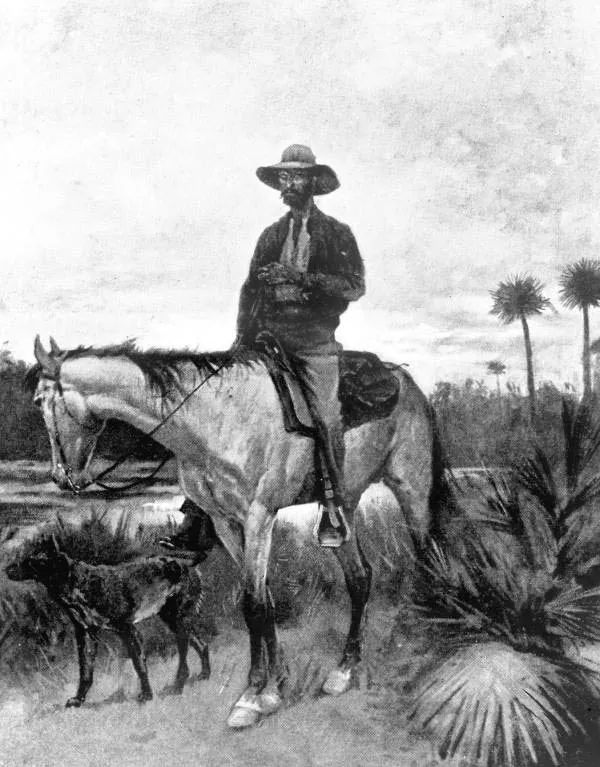
They were not called cowboys here. They were cow hunters, and the name is exact, because the job really was hunting. The cattle were loose somewhere in miles of palmetto and pine, and you went looking.
You did it on a small, wiry horse descended from the same Spanish stock as the cattle, with a pack of cow dogs to push the animals out of the brush. And you carried a long braided-leather whip, twelve feet of it, that you could pop like a gunshot to move a herd through scrub too thick for a rope to be any use.
That whip is where the argument starts. The popular story says the loud crack of it is exactly why these Floridians got called “Crackers.” It is a great story. It may even be partly true. But word historians will tell you the term is older than Florida cattle, and first meant a loud-talking braggart. So take the whip version as the one everybody loves, not the one everybody can prove.
No fence, so the mark was the law

Here is the part that makes the Spanish name click into place. On open range, with the cattle all mixed together, how did anyone know whose cow was whose?
By the mark. Every owner burned a brand and notched the ears in his own pattern, and that mark, not a fence, was the proof of ownership. It was honored at roundup, argued over, and now and then settled the hard way, out in the scrub, by the men holding the rifles.
And that is the exact thing the word estancia was invented to describe. In the Spanish-speaking cattle lands, an estancia was the moment the roaming, unowned animals became marked, counted property on a fixed piece of ground. A ranch. The name on this Windermere gate is pointing straight back at that, whether the sign maker meant it to or not.
They built what the work needed, out where the work was

A cattle outfit this far out could not run back to town at night, so it built on the spot. A cow camp was a rough open roof and a log pen beside a lake or a creek, enough to hold the herd and sleep the men until the work moved on.
It is a small thing, but it is the whole Florida habit in one picture. You had land and you had a job to do on it, so you put up a plain building right where you needed it and asked nothing more of it than that. Nobody drew plans. You built what the work needed.

Cattle were also the money. Not a figure of speech. Florida cowmen drove herds down to the coast and sold them to Cuba for Spanish gold coins, and a man could carry his wealth in a saddlebag. That is why a loose, markable cow was worth riding into thick brush for, and worth arguing over when two marks met.
The thing that ended it was a fence

For most of its history Florida simply let the cattle run, and it held onto that longer than anyone. It was the last state in the country to make cattle owners fence their animals in, and that law did not pass until 1949.
When it did, the whole old world turned over almost at once. The cow could no longer wander, so the cow hunter stopped hunting. The brand gave way to a property line. The open range, the thing the land had been for three and a half centuries, closed in about the length of one person’s childhood.
The cattle went behind wire. The groves that shared this ridge went to freezes and then to houses. And the country that had been one big unfenced estancia got cut into lots and lanes and the Windermere we drive through now.
What the fence could not take

Two things from the old range are still out here, if you know to look.
The cattle themselves, for one. The scrubby Spanish breed has a name now, Florida Cracker cattle, and it still grazes pastures a short drive from Windermere, down toward St. Cloud and out past the edges of the metro. The tough little Spanish horse made it too.

And the other thing is the room. Windermere and the rural pockets around it, Gotha just east, the lanes out toward Oakland and Winter Garden, held onto the one feature the open range was built on: space. The town kept its big lots on purpose, even its sand streets. So the yards out here are still deep and wide, the generous kind of ground that a place running cattle always needed.
The fence came, and the groves left, and the cow hunter hung up his whip. But the ground never stopped being what it was. This is still a place with room on it, and room, out here, was always an invitation to build the thing you needed on it.


