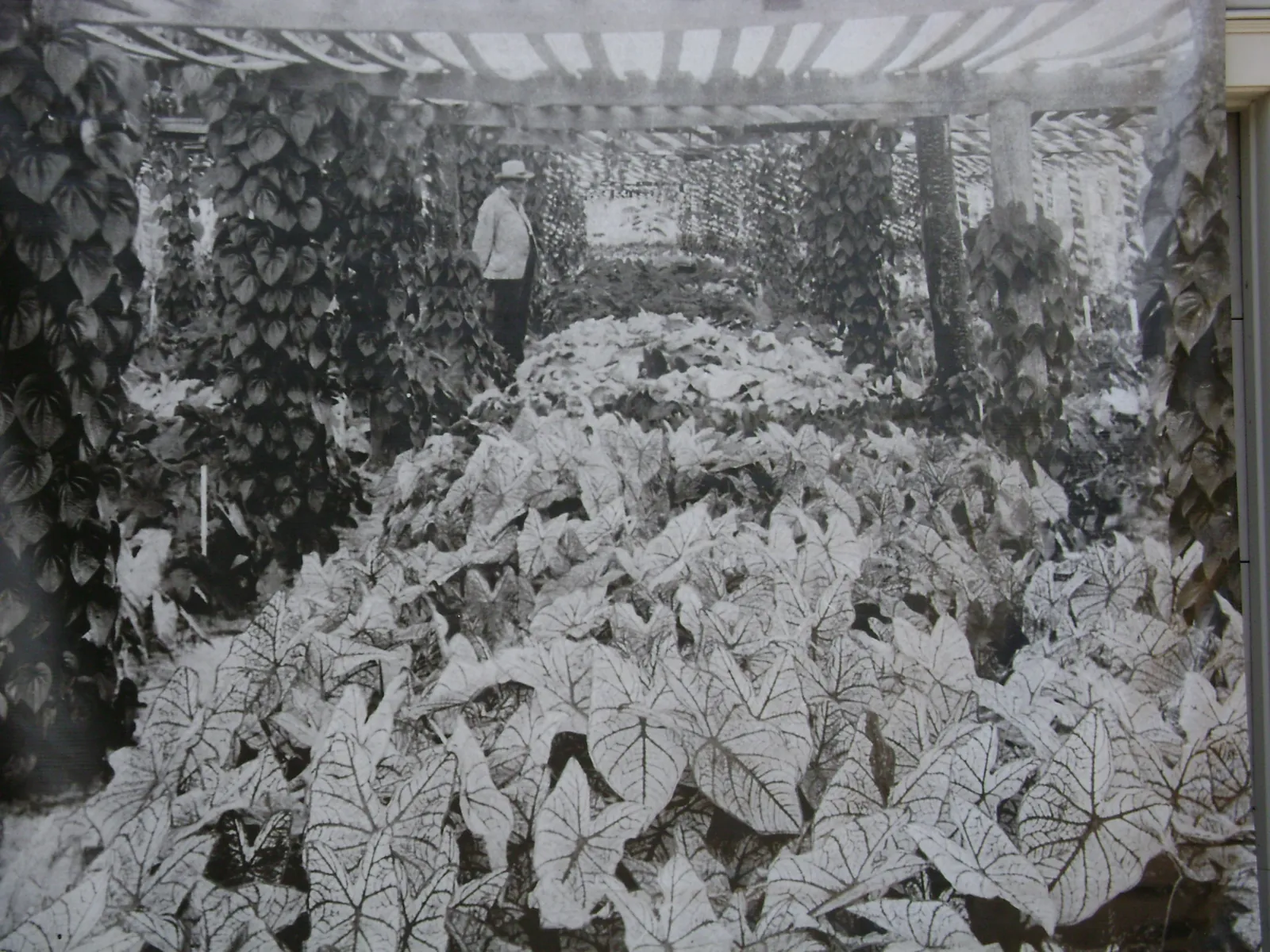
Walk into that picture and you are standing in the middle of what one man did with a Florida back lot in 1908. Thin wood slats overhead, cutting the sun into stripes. Underneath them, a flood of painted, heart-shaped leaves running off in every direction, and the man himself in a pale suit near the back, half lost in his own plants. Every neighbor he had was growing oranges. He was growing this.
So who looks at good grove land a few miles from Lake Butler and decides to fill it with leaves nobody can sell by the crate? That is the whole question, and the answer turns out to be the most Central-Florida thing imaginable.
First, where this is
The ground is Gotha, a little German settlement sitting just up the road from the Butler Chain, in the grove country west of Orlando. It is close enough to Lake Butler that the two belong to the same story.

Out here the move was always the same. Get a piece of ground with room on it, and build whatever your life needed out back: a grove, a barn, a packing shed, a little cottage for the hired hand. The land was cheap and there was plenty of it, so nobody was trying to fit much onto a little. You spread out.
The crop everyone bet on

And what their life needed, almost always, was oranges. This was citrus country, the sandy high ground where anyone with a few acres and some nerve planted orange trees and waited to get rich on them. The lakes helped: a big body of water holds the day’s heat and gives it back slowly after dark, so a grove ringed by water could ride out a cold night that stripped the trees a few miles inland. That is why the groves crowded the Butler Chain. If you had the room near the water, you planted fruit. That was just what land was for.
One man looked at the same ground and did the other thing.
The man who zigged

His name was Henry Nehrling, and he came to it sideways. He was a schoolteacher, born to German parents up in Wisconsin, and the thing he was first known for was not plants at all. It was birds. He wrote a thick two-volume book on the birds of North America, the kind of work that gets a man taken seriously by other serious men.
Somewhere in the 1880s and 1890s he bought up around sixty-five acres at Gotha. By 1904 he had moved the whole family down for good, and he did it the way people did out here: piece by piece, hauling a separate kitchen building onto the place behind an ox team. He had his room. Now he had to decide what to build on it.

He built a laboratory
Here is the turn. He did put in some oranges, like everyone else. But the real thing he built out back was not a grove. It was a laboratory.
He put up lath houses, shade sheds framed out of thin wood slats, and he put up acres of them. Then he started collecting plants the way other men collected money. The federal government was just then sending people around the world to bring back useful plants, and Nehrling became one of their outside hands, a grower who would take whatever strange seed or bulb arrived and find out whether it could live in Florida. He ran more than three thousand kinds of plants through that ground.
Better than three hundred of them stuck. And they are not museum pieces. They are the ordinary green stuff of every Florida yard since: palms, bamboos, the crinum lilies by the mailbox, the amaryllis, the hawthorn hedge. A good part of what grows in your neighbor’s yard today was first tried out in a slat house in Gotha.

The ones he loved best were the caladiums, the painted leaves in the opening picture. He had first seen the wild tropical kind at the Chicago world’s fair in 1893, at the Brazilian exhibit, and he spent years crossing them into the fancy-leaf varieties people still buy. In a strong year he set out something like twenty-five thousand of them under his slats, a whole shaded field of color with a man walking the rows. The caladium trade in Florida more or less begins in his back lot.
His neighbors grew a crop to sell. He grew a collection, and a good part of it ended up in your yard.
Word got around

A lath house in Gotha had turned into a place worth the trip. The plant men came, the sort who ran the country’s plant hunting, and over the years the stories pile on bigger names than that, Edison and Roosevelt among the ones people still drop. The company you can actually prove he kept was horticultural, not presidential. Either way, a schoolteacher with a bird book had made himself one of the people you asked when you wanted to know whether a thing would grow in Florida.
Then the cold came, the way it always does
And then the thing that comes for every Florida grower came for him too. A hard freeze in 1917 killed off his commercial caladiums, the crop he had built a business on. He was in his sixties.
He did not quit. He started over, opening a second garden far down south near Naples, where the cold had a harder time reaching, and he kept collecting right to the end. He died back at Gotha in 1929, in the house with the garden still closing in around it.
What is still out there

The groves his neighbors planted are mostly gone, frozen out and bulldozed and turned into streets and gated entrances like everything else out here. Nehrling’s house is not. A garden society owns the surviving acres and keeps the place up. The old frame house with its double porch is still there, the brick well is still in the yard, and the bamboo and palms he set out are tall enough now to hide the roof. The land went on the National Register of Historic Places in 2000.

So the oldest thing about this corner of Orange County turns out not to be the oranges. It is the room, and the nerve to build whatever you wanted on it. One man used his to grow a laboratory full of painted leaves, and it has outlasted every grove around it. Stand in the overgrown yard at Gotha, the slat houses long gone but the bamboo still roaring up over the roof, and you are looking straight at the real local tradition: a piece of ground with space out back, and somebody who decided to build something worth keeping on it.


