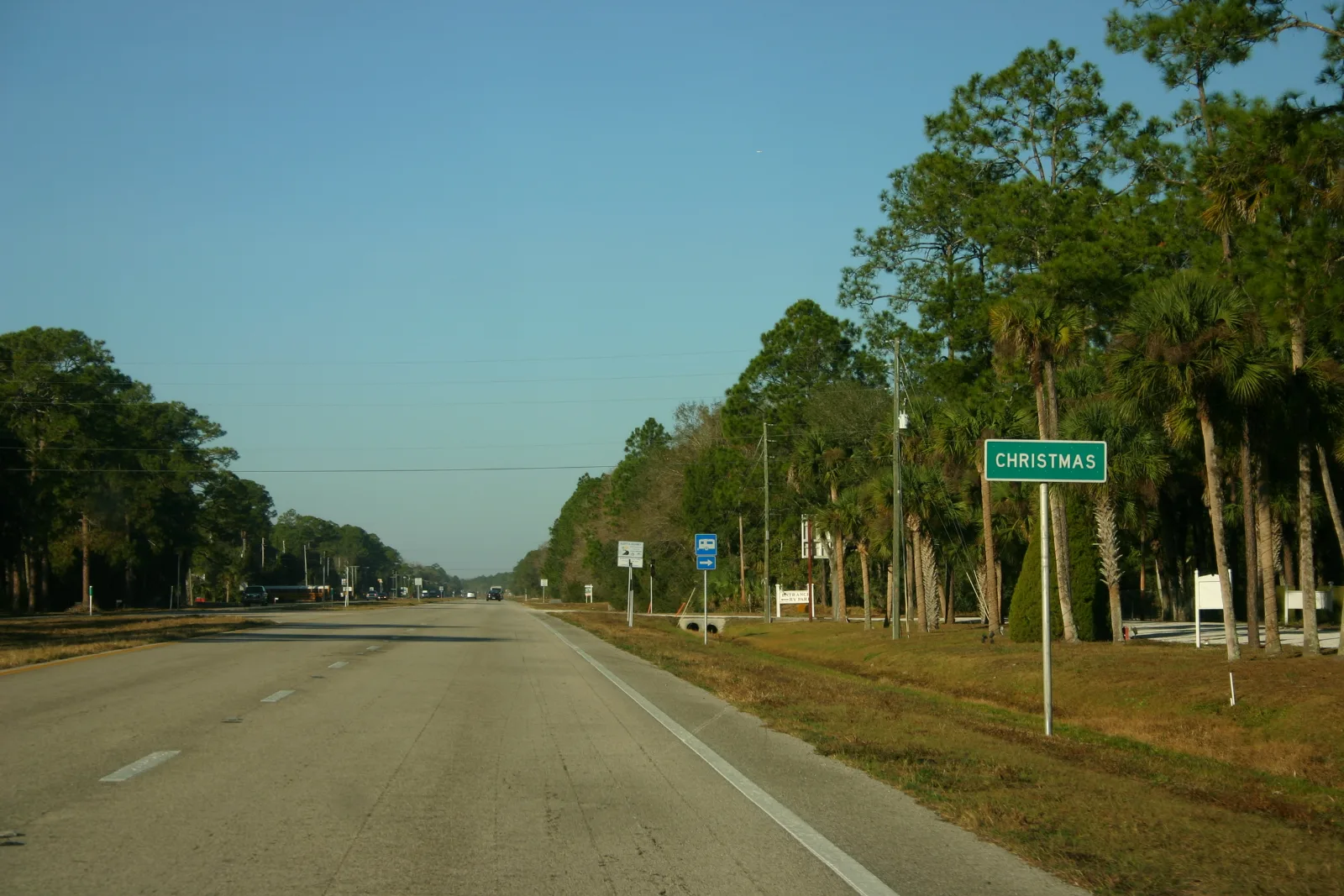
Drive east out of Orlando on State Road 50, past Bithlo, and the strip malls thin out, then the subdivisions, then pretty much everything. The land opens up into pine flatwoods and pasture and the odd horse behind a long fence. And then, with almost no warning, a plain green sign tells you that you have arrived in Christmas.
Not at Christmas the holiday. In Christmas the town — population about eleven hundred, with a post office, a permanent lit tree, and streets named Rudolph and Blitzen. People assume there is a cute origin story. There is, but it is not the one they expect.
The name is a soldier’s shorthand for a date. And the reason it stuck has almost nothing to do with the holiday, and almost everything to do with how much room there was out here.
A fort built in a week, named for the day
On December 25, 1837, in the middle of the Second Seminole War, roughly two thousand U.S. soldiers and Alabama volunteers came up this way with a thousand horses and seventy wagons, under Brigadier General Abraham Eustis. They stopped near a creek and started building a fort.

It went up fast — a palisade of palm logs, roughly eighty feet on a side, with a blockhouse at opposite corners, finished in a little over a week. Being Christmas Day when they broke ground, somebody called it Fort Christmas, and the name went into the record.
Here is the part people never guess: no great battle was ever fought at its gate. Fort Christmas was a supply depot — a place to stack rations and move troops deeper into the interior. The war rolled south, the soldiers followed, and within a few years the fort was empty. It sagged, burned, and rotted back into the palmettos.

What the army actually left behind was not a fort. It was a line on a map, a name, and a working knowledge of a stretch of Florida that most people had written off as empty. And empty land, it turns out, is a kind of invitation.
What the soldiers left was room
The families who drifted in after the war did not come for a town. They came for the space. You could put your hands on a big piece of this country for very little, if you were willing to live a long way from anyone who could help you.
So they spread out. Not shoulder-to-shoulder on village lots, the way a Winter Park or an Orlando was being platted. Out here it was homesteads — a house set back on its own acreage, with the next family a creek or a cattle gap away.
Christmas was never really built as a town. It was built as a scatter of homesteads, each one with room to do whatever the family needed.
Cattle you could drive, and groves you could smell
What the land was good for was animals and fruit. The grassy prairies running down toward the St. Johns River were open range, and cattle did well on them with almost no help. A herd was food and it was money, and the men who worked it — Florida’s cow hunters — cracked long whips instead of roping, which is part of where “Cracker” comes from.

It was not the cattle country of the picture books. It was lower, wetter, buggier, flatter. But there was a lot of it, and a man with a horse and a few head could make a start.

Where the ground sat a little higher and drier, families planted citrus. An orange grove in this part of Florida was not landscaping — it was a bank account that happened to smell wonderful, a few acres you tended all year and sold off a wagon in the winter.

Build what you need out back
And here is where the room really shows up — not in how much land a family had, but in what they did with it. A homestead out here was almost never one building. It was a little cluster.
The main house sat up off the ground on blocks, with a wide porch and a straight hall running front to back — a “dog-trot” — so a breeze could blow clean through. And the kitchen? The kitchen was usually its own separate building, set a few steps out back.

Part of that was fear of fire — a cook fire that got away from you took the cookhouse, not the family. Part of it was the heat; nobody wanted the stove in the room they slept in come July. Either way, the instinct was the same: when you need another room’s worth of use, you don’t cram it into the house. You build a second little building and put it out back.
And the kitchen was just the start. Out behind the house you’d find a smokehouse, a corn crib, a tool shed, a barn, a syrup kettle under its own little roof — a whole working yard of small structures, each one doing one job.
The homesteads that had to be moved to survive
For a long time, this corner of Orange County stayed exactly that empty. Then Orlando grew east — the highway got wider, the price of land woke up, and the old homesteads started coming down.
So people did something unusual to save them. They picked the buildings up and moved them — whole Cracker houses, a schoolhouse, cow camps, a cane mill — and set them back up together on one piece of county land beside the replica fort. Fort Christmas Historical Park is, in a real sense, a neighborhood of homesteads that were carried here from all over east Orange County.

Stand in the middle of it and you can read the whole habit at a glance: a modest main house, and then the extra buildings a family added as it needed them, spaced out across the grass with room to breathe between. Nobody was trying to be tidy. They were trying to be useful.
The name that refused to leave
Through all of it, the name hung on. A post office opened in 1892, and the town quietly dropped the “Fort” — a letter postmarked simply Christmas, Florida was already a small thrill.
One family leaned all the way into it. Juanita Tucker ran the Christmas post office for better than forty years, from the early 1930s into the 1970s, and turned the holiday postmark into a tradition. Every December, cards and parcels still pour in from around the country to get stamped here before they go back out.

A year-round lit tree stands at the main crossroads, and the little grid of streets is signed Cupid and Dasher and St. Nicholas. It is genuinely charming, and it is also a bit of a magic trick — because the holiday is the thing people drive out here to see, and the land is the thing that actually made the place.
What’s still out there
The fort you can visit is a careful rebuild. The homes in the park were carried in from somewhere else. The one thing in Christmas that was never relocated, never rebuilt, and never really changed is the room — the big lots, the pasture, the acreage, the space between one house and the next.
Drive those back roads today and you will still see it everywhere: a main house near the road, and out back, a second little building. A workshop. A barn. A cottage for somebody’s mother. The particular Christmas habit — when you need more, you build it out back — never went anywhere. It just stopped being a cookhouse and became whatever the family needs now.
.jpg)


_(3251764870).jpg)