Apopka, Florida  ·  A Local History

The Town That Grew the Country’s Houseplants


Most people only know it as a name on the turnpike north of Orlando. But for about a hundred years, Apopka lost its oranges to the cold, filled its back acres with slat-board shade, and quietly grew most of the greenery in America’s living rooms.

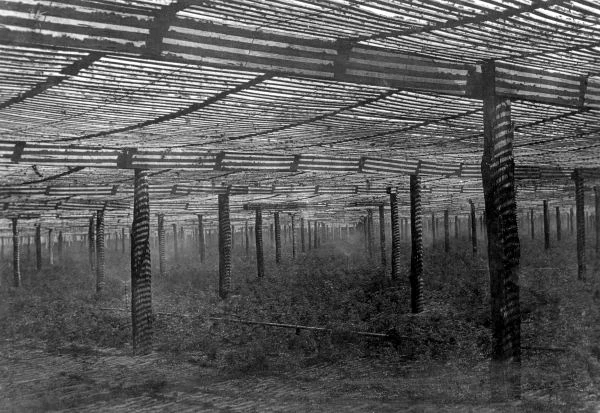
Rows of ferns growing in the dappled light under a low slat-board roof held up on wooden posts, the lath breaking the sunlight into stripes.
Shade you could build
The whole idea, in one shed. Ferns growing under a slat roof in the Central Florida fern belt — the kind of manufactured shade that replaced the orange groves. Royal Fernery, Altamonte Springs, just east of Apopka. State Archives of Florida.

There’s a decent chance a plant on your windowsill got its start in Apopka — a town most people only clock as a sign on the turnpike north of Orlando. For about a hundred years Apopka went by a bigger name, the Indoor Foliage Capital of the World, and it earned it. The ferns and philodendrons and little potted things that filled the country’s living rooms were mostly grown right here, under acres of slat-board shade.

Which is a strange thing for a town to become. So how does a flat stretch of Central Florida end up growing the nation’s houseplants? The answer starts with a crop that died in two nights.

Before it was Apopka, it was “The Lodge”

Start with the name people used first. In 1856 a handful of settlers got a charter for a Masonic lodge out here — Orange Lodge No. 36 — and by 1859 they’d put up a plain two-story frame building at what’s now Main Street and Alabama Avenue. For sixteen years the whole settlement just went by “The Lodge.” That building is still standing, still used by the same lodge — the oldest Masonic meeting hall in continuous use in Florida.

A plain white two-story wood-frame building with a gabled roof and a small sign, standing on an open corner lot.
“The Lodge” — built 1859
The building the town was named for. Orange Lodge No. 36, chartered in 1856 and built in 1859 — the oldest Masonic meeting place still in use in Florida. The settlement went by “The Lodge” until 1882. State Archives of Florida.

The town took the name Apopka when it was chartered in 1882, from the Seminole word Ahapopka — roughly “potato-eating place” — for the big lake just west of it. The railroad arrived in 1885. And like every other town out here, Apopka put all of it on one crop.

An orange town, like all of them

That crop was citrus. Orange groves ran right up to the edge of the streets, and the barrels of fruit went out on the new railroad to New York and Boston and Baltimore. The money was very good. You could buy a piece of ground, set out trees, wait a few winters, and get paid every year the North froze solid and Florida didn’t.

A quiet small-town main street lined with low brick storefronts and tall palms, a single traffic signal hanging over the empty road.
Fourth Street, Apopka
The orange town’s main street. Fourth Street in Apopka — storefronts, palms, and the groves running up close behind them. State Archives of Florida.

So people did the obvious thing. They bought their acres, cleared a little ground, put in a grove, built a house, and settled in to grow oranges more or less forever. A couple would pose out among their own trees like they’d found the one sure thing in the world.

A woman in a long white dress and a man in a straw hat standing beside a horse and buggy at the edge of a grove, scrub and trees behind them.
Their own grove, around 1915
The sure thing. Benjamin and Ella Hawthorn in their orange grove in Apopka, around 1912–1918 — the picture of a family that had bet on citrus and won. State Archives of Florida.

Then one winter the weather did the single thing nobody had planned for.

The winter the oranges froze

It came in two nights, six weeks apart. On December 29, 1894, the temperature in Orlando dropped to 18 degrees. The groves took that first hit and might have pulled through — until a second freeze in early February 1895 caught the trees with the sap already running warm and split them open.

A grove of orange trees stripped bare by cold, bare branches against a pale sky and the ground beneath littered with fallen leaves and fruit.
After the freeze
What the cold left. An orange grove killed back by cold — this one at Bartow, but groves all over Central Florida looked like this after the freezes of 1894–95. State Archives of Florida (Louise Frisbie collection).

Across Central Florida, growers who’d shipped thousands of acres of fruit the winter before now shipped almost nothing. Fortunes in orange trees turned to black wood in a couple of nights, and a lot of people packed up and left. The ones who stayed were left with a hard question: what do you grow on a piece of ground when the thing it was for just died in the cold?

So Apopka grew shade

Apopka’s answer was almost funny. Instead of a fruit that wanted every bit of sun it could get, the growers who stuck around turned to a plant that couldn’t stand the sun at all — a feathery green they called asparagus plumosus, which florists up north bought by the crate to tuck into bouquets.

It isn’t even botanically a fern — it’s a cousin of the asparagus you eat, dressed up and sold to florists as “fern.” But it needed shade to grow, and shade was something you could build.

A tall 1924 newspaper advertisement headed 'ORANGE COUNTY,' listing the county's farm products, with a section on FERNS and a line reading 'Orange County Has Room for You.'
1924: “See Apopka and Zellwood”
The new crop, in print. A 1924 Orange County ad calls ferns “a new, attractive and profitable industry … See Apopka and Zellwood” — and, lower down, “Orange County Has Room for You.” Florida Times-Union, 1924; State Library of Florida.

So that’s what Apopka built. Acres of it — low slat roofs on posts, lath laid just close enough to break the sun into stripes, a whole landscape of made shade thrown up over the same back ground that used to hold groves. Growers cut the ferny sprays, packed them in ice, and sent them north on the same railroad that used to carry oranges. By the 1920s there were so many ferneries around town that Apopka stopped calling itself an orange town and started calling itself the Fern City.

From a dime-store fern to the whole country’s houseplants

The next turn is what made it an empire. The five-and-dime chains — Woolworth’s and the rest — began buying Apopka’s fern sprays to sell in their stores, and then they came back and asked the growers a bigger question: could you grow us something that lives in a pot on a windowsill?

Big heart-shaped caladium leaves with pale veined centers growing thickly in a shaded spot beside a wooden wall.
Caladiums under the shade — Apopka, 1960
What else the shade could grow. Caladiums at Thompson’s Nursery in Apopka, 1960 — painted leaves that did fine in a pot indoors. State Archives of Florida.

Apopka could. The shade houses that grew fern sprays could just as easily grow potted things — caladiums with their painted leaves, philodendrons, a hundred kinds of green that held up in a Northern apartment where nothing else would. The business climbed for decades. Family nurseries spread across Apopka and out toward Zellwood and Plymouth, each one a few back acres of benches under lath.

A man working among long benches of leafy potted plants inside a greenhouse, rows of foliage running back to the far wall.
A family nursery at work
Somebody’s back acres. David Barringer and his son working the greenhouse at Thompson’s Nursery in Apopka, 1960 — one of the hundreds of family operations that grew the country’s houseplants. State Archives of Florida.

By the 1960s the town had a new and even bigger title: the Indoor Foliage Capital of the World. For a long stretch, most of the houseplants sold in America came out of these few square miles of shade — boxed and trucked out to every corner of the country.

A wooden shipping crate stamped 'ASPARAGUS-PLUMOSUS' lined with plastic and packed with bundled green fern sprays ready to ship.
Boxed and going north
The crop that started it, still shipping. Asparagus-plumosus “fern” packed for shipment at a Central Florida fernery, 1985. State Archives of Florida (Florida Folklife collection). A representative fern-belt operation.

What it was really about

Strip off the ferns and the caladiums and you’re left with the thing that actually carried Apopka through both lives: room, and the habit of using it. Every one of those nurseries was somebody’s back ground — the acres behind a house that a family filled with shade houses, benches, and the next crop they were betting on.

A color postcard of a Florida home set back among shade trees, two small figures in the yard, with a printed caption reading 'A pretty Florida home, Apopka.'
“A pretty Florida home” — Apopka, 1906
A house, and the ground around it. A hand-colored postcard of an Apopka home, around 1906 — trees, a yard, and room out back to put the next thing on. State Archives of Florida (Postcard collection).

When the oranges died, the room didn’t. It was still there, waiting to hold whatever came next. That’s the move Apopka pulled off twice inside a single lifetime: take the ground you’ve got, and put the thing you need out on it — a grove one decade, a shade house the next.

So the plant on your windowsill really might be from here: a town that lost everything it was built for in two cold nights, looked at the empty ground out back, and decided to grow shade instead. The groves are mostly subdivisions now and the big ferneries have thinned out — but drive the roads around Apopka and Zellwood and you’ll still pass them, the long low shade houses sitting on somebody’s back forty, still growing.

A present-day note · Orange Tiny Homes

The room out back is still the whole idea.

Apopka’s trick was never really ferns. It was the room — the ground behind the house, and the willingness to put something useful on it when life changed. A grove, then a shade house, then whatever paid next. That room was the one thing the freeze couldn’t take, and it’s what let people build what they needed, when they needed it.

That instinct still pays, and the thing people build out back now has a name — an ADU, an accessory dwelling unit. That’s our whole job. A granny flat so a parent can live close with their own front door. A guest house. A rental out back that helps carry the mortgage. A tiny home in the far corner of the lot. The same move Apopka made — use the room you’ve got — just with a kitchen, a bathroom, and a permit.

And you don’t need acreage to do it. All across the greater Orlando area — the deeper lots out toward Apopka, Zellwood, and the rural edges, sure, but plenty of ordinary yards closer in too — the room is already there. What actually decides it comes down to a handful of facts about your own address:

The real answer to “is there room out back for this?” isn’t a guess — it’s those few facts about your lot. That part we can check for you.

Put in your address and we’ll pull what your parcel allows and tell you whether a granny flat, guest house, rental, or tiny home actually fits — before you spend a dollar on drawings.

Start the ADU Fit Check→
Sources & Photo Credits

On the history

Where accounts differ: the lodge’s charter date appears as January 1856 in most sources (a few give the exact day as the 14th or the 16th); this page uses “1856.” Asparagus plumosus (Asparagus setaceus) is sold in the trade as “fern” but is not a true fern; it is in the asparagus family. The 18°F reading is for Orlando, a few miles south of Apopka. Several of the photographs are genuine images of the Central Florida fern/foliage belt used to show what Apopka’s shade houses, nurseries, and shipping looked like; each is labeled above as specific to Apopka or representative. Full research notes are in source-record.md beside this page.

Photographs & documents

  1. Ferns under a slat roof (hero) — ferns growing in the dappled light under a lath roof, Royal Fernery, Altamonte Springs, Seminole County. State Archives of Florida, Florida Memory (AHS0392), Altamonte Springs collection. Representative of the Central Florida fern belt that included Apopka. File: ferns-under-slat-roof-royal-fernery-altamonte. floridamemory.com/items/show/330036
  2. Orange Lodge No. 36 (“The Lodge”) — the Masonic lodge building in Apopka, “chartered Jan. 1856, built and occupied since Oct. 21, 1859” (per the negative sleeve); photonegative of a mid-century postcard. State Archives of Florida, Florida Memory (N027767). Specific to Apopka. File: apopka-orange-lodge-no36-masonic. floridamemory.com/items/show/137508
  3. Fourth Street, Apopka — a street scene in downtown Apopka, photonegative of a postcard. State Archives of Florida, Florida Memory (N027775). Specific to Apopka. File: apopka-fourth-street-postcard. floridamemory.com/items/show/137516
  4. The Hawthorns in their orange grove — Benjamin Madison Hawthorn (1865–1933) and Ella Boyles Hawthorn in their orange grove in Apopka, about 1912–1918. State Archives of Florida, Florida Memory (N047917). Specific to Apopka; a modern caption bar across the bottom of the scan was cropped off. File: apopka-hawthorn-couple-orange-grove. floridamemory.com/items/show/155817
  5. Freeze-damaged orange grove — an orange grove killed back by cold at Bartow, Florida (Streaty Parker’s grove); the archive notes that groves across the state looked like this after the freezes of the 1890s. State Archives of Florida, Florida Memory (FR0323), Louise Frisbie collection. Representative of the 1894–95 freeze damage across Central Florida. File: orange-grove-cold-damage-bartow-1890s. floridamemory.com/items/show/117876
  6. Orange County advertisement, 1924 (document) — a full-page ad in the Florida Times-Union’s Florida Roads and Resorts, 1924, headlining the county’s produce and promoting ferns (“See Apopka and Zellwood”) and land (“Orange County Has Room for You”). State Library of Florida, Florida Collection (917.59 F636), via Florida Memory. File: orange-county-advertisement-1924. floridamemory.com/items/show/318842
  7. Caladiums under shade, Apopka — caladiums growing in a semi-shaded spot at Thompson’s Nursery, Apopka, April 1960. Photograph by Charles Lee Barron. State Archives of Florida, Florida Memory (C032452), Department of Commerce collection. Specific to Apopka. File: apopka-caladiums-shade-thompsons-nursery-1960. floridamemory.com/items/show/57741
  8. The Barringers in the greenhouse, Apopka — David Barringer, Sr. and Jr. working in the greenhouse at Thompson’s Nursery, Apopka, 1960. Photograph by Charles Lee Barron. State Archives of Florida, Florida Memory (C032455), Department of Commerce collection. Specific to Apopka. File: apopka-barringer-greenhouse-thompsons-nursery-1960. floridamemory.com/items/show/77358
  9. Packing asparagus-plumosus fern — a crate stamped “Asparagus-Plumosus” packed with fern sprays at the Hagstrom family fernery, Pierson, Volusia County, 1985. State Archives of Florida, Florida Memory (FP86127A), Florida Folklife collection. Representative of the fern-belt packing-and-shipping work. File: packing-ferns-in-box-fernery-pierson-1985. floridamemory.com/items/show/115988
  10. “A pretty Florida home,” Apopka — a hand-colored postcard of an Apopka home, published by Franz Huld, New York, between 1901 and 1906 (postmarked December 1906). State Archives of Florida, Florida Memory (PC0209), Postcard collection. Specific to Apopka. File: apopka-pretty-florida-home-postcard-c1906. floridamemory.com/items/show/157832

Original downloads and the full research record are kept alongside this page in assets/images/originals/ and source-record.md. No historical image was altered in a way that changes its content; a modern caption bar was cropped from the Hawthorn grove photograph, and images were resized and lightly adjusted for tone for the web. The Polaroid frames and handwritten notes are CSS styling added around the images, never onto them.